When I arrive in a new city, I have a bit of a thing for finding the highest point around. This is for two reasons: first, because I like a good view, and second, in an attempt to orientate myself.
The orientation part only vaguely helped on my recent trip to Barcelona. The city is seriously maze like, particularly the old pedestriansed parts of the city centre. However, since wandering around maze like alleys getting lost is another thing I enjoy about a city, that wasn’t really a terrible issue.
If you’re heading to Barcelona, and like me have a tendency to head for the high points of a city like a fly that’s been taken over by a brain controlling fungus, here’s a quick run down of my four favourite places to get a great view of the city for free!
Parc Güell
I have mentioned the influence that Gaudí has had on Barcelona already. Parc Güell is one of the highlights of his legacy, and a UNESCO world heritage site to boot. It has incredible features, from raised balconies, to enormous sculptures, to weird and wacky houses.
What it also has is one of the finest views of Barcelona, available from a number of locations in the park. The most popular is up by the cross above the main entrance, but you’ll be able to get a fabulous view from pretty much everywhere in the park, what with it being up on a hill, without fighting for the perfect spot to take a photo.
If you go to Barcelona, you will visit Parc Güell. You may as well enjoy the view whilst you’re there!
Castell de Montjuic
If you have a convenient hill with a cliff situated next to a large harbour, it makes sense to build a nice big castle on top of it complete with guns to guard said harbour.
Montjuic Hill, rising to just over 180 metres above Barcelona harbour, is just such a hill, and features a rather splendid bit of fortification at the top, complete with rather large bits of defunct weaponry.
From here you are able to get a commanding view across the city of Barcelona as well as the harbour. The reverse view, in fact, that you can see from the photo taken from Parc Güell above.
You can also explore the Castle for free, although it isn’t really a castle so much as a large pile of walls designed to keep people safe, coupled with incredible views.
As an historical aside, Castell de Montjuic was also the place that the calculations that defined the measurement of the metre took place. In case you weren’t already aware, a metre is defined as being one ten millionth of the distance between the north pole and the equator. Which seems a marginally less arbitrary measure than the length of some blokes foot. A great view and a bit of metric history. What a combination!
Tibidabo
As you wander around the city of Barcelona and explore the other high bits that I’ve mentioned here, you will notice in the distance a large hill with a big church sitting on the top.
This is Tibidabo, the largest hill that looks over Barcelona, rising to a rather impressive half a kilometre above sea level.
Perched atop this hill are all kinds of things, including the Temple de Sagrat Cor, an amusement park, and an absolutely enormous telecommunications tower. You can go up the latter for even more staggering views, but that’s not free.
Getting to the top of the Tibidabo can be achieved on foot, making it free, but if you’re short on time, or not feeling up to it, you can drive, take the bus, or hop on the funicular railway. You can see the communications tower and church in the next photo which is taken from the:
Roof of Las Arenas
We stumbled across this location quite by accident when heading to Barcelona’s Magic Fountain. A city with a magic fountain! What’s not to love? Anyway, Las Arenas is a large circular shopping mall just near the Magic Fountain.
This probably doesn’t sound too exciting, until you realise that it has been transformed from what was once Barcelona’s famous bull fighting stadium, also known as Las Arenas.
When bull fighting fell out of favour in this corner of Spain, the building became somewhat derelict, until its recent revival as a shopping mall.
Its entire roof is a circular promenade, upon which you can wander to your hearts content, gazing across such sights as Montjuic Hill, the Magic Fountain, the nearby Parc Joan Miro and the wonderful skyline of Barcelona. Not bad for free!
Have you been to Barcelona? Any other places you’d recommend for a great view? Do let me know in the comments below!
I recently had the absolute pleasure of visiting Barcelona for a week. I’ve got a number of posts up already, including one on what I learnt and one stuffed full of photos of Gaudi’s masterpieces. More posts will be coming on the Barcelona theme – this is one awesome city!
Today’s post is all about where I stayed in Barcelona. I went for an apartment rather than a hostel or hotel for the trip - it’s an accommodation option I’ve mentioned before as being highly practical for the independent traveller. They offer a great deal of flexibility married to that other thing folks get excited about: namely a good price.
I was therefore delighted to partner with Roomorama for my trip to Barcelona. They helped out with the cost of my accommodation, and I get to share my experiences with you. But first:
Win Stuff!
If reading my prose wasn’t enough for you, I’m also happy to say that Roomorama are offering three of my readers (that’s you!) the chance to try out their service, and are giving away three Roomorama credits worth 50 USD each, or equivalent in your currency.
Even more excitingly, this prize is open to you wherever you are in the world, none of those annoying geographical restrictions on my watch. The only thing you need to do is use the credits within six months of winning them. Easy!
You can enter right now using the rafflecopter entry below. It’s pretty straightforward – the more tasks you complete, the more entries you get. Then, why not check out the search widget on the right hand side of the blog page to start planning where you’ll go if you win!
The contest will be running until the 11th May to give everyone a chance to enter, and I'll contact the winners once they’ve been chosen with all the details of their winnings!
What is Roomorama?
But wait, Laurence, you say. Sure, I’m all up for winning fifty dollars worth of free accommodation anywhere in the world that Roomorama operates. In fact, I’ve already entered. But.. what am I entering to win? Who are these Roomorama’s, and what can I do with their credits?
This questions is nice and easy to answer. Roomorama is a service that puts people who have property available for short term lets in touch with people who want to stay in property for a short period of time. It’s the classic consumer to consumer model of business that you will know from your marketing 101 class. (You did take marketing 101, right?)
Roomorama’s website lets you search for properties in locations all around the world. It then lets you filter your search by all kinds of options, including price, number of bedrooms and even amenities such as internet access or whether or not the property comes with a pool.
Properties available run from the simple “I have a room to spare in my house and you can come live with me if you like” right up to some seriously luxurious penthouse style apartments. Those didn’t fall inside my budget for this trip. Maybe next time…
Once you’ve found a property you like, with a price range, location and amenities list that matches your needs, you fire off an inquiry to the host, who will get back to you to confirm (or deny) availability and the overall price. If you’re both happy, then you just go right ahead and confirm. You then pay your money to Roomorama, who give you a code to present to your host.
What’s good about it?
The best thing about the Roomorama service, in my opinion, is the way it keeps your payment secure. You don’t pay the host directly, and they can’t get at your money until they get your code, which you give in person when you meet them at the property. This is the main advantage of using a third party system over something like a classified ad.
The rest of the service is also well polished. The site is easy to use and navigate and there are loads of ways to filter the results to get exactly what you want. You can also read reviews on the properties and on the hosts prior to making a decision, to make sure the nice description matches what people found.
The overall benefits of an apartment compared to other types of accommodation are also myriad. You have the place to yourself, to come and go as you please. You can save money by cooking for yourself, you can pop to the markets, and you feel like you have your own little house in your destination. Perfect if you’re over hostel life.. but aren’t quite ready for the impersonal practicality of a hotel room.
What could be improved?
You know, I’m racking my brains here. All the things that you could complain about with a service like this are common to this type of operation, where a site is operating as a third party go-between rather than directly offering a product.
So yes, you may end up with a turkey of an apartment. There is a review system in place, but if no-one has stayed in the apartment with Roomorama, or left a review, then you could be the first to discover a disaster. And there are plenty of properties without reviews at the time of writing this article.
There is what is called a “certified host” program, but this just means that the host has had three positive reviews from other clients – better than none, although you need to rely on your travelling peers.
Roomorama could of course inspect all the apartments that are advertised, but this would probably add such a cost to the operation that it would no longer offer good value. Maybe they could offer hosts the option to pay to have their property “validated”, for peace of mind.
There is also the potential issue of time lag between enquiry and booking, although again, this isn’t specifically a Roomorama problem. When you are travelling independently and booking a variety of things at the same time, it can be vexing to have to wait for a reply to confirm availability on accommodation prior to booking your transport, particularly as good deals have a habit of vanishing quickly.
As communication between you and the host is handled through the Roomorama system, you have to wait for your host to check their mail and get back to you. If the host is away from their e-mail, this could cause you a problem, although there are usually enough properties available that you could have backup options on hand easily.
This is a very minor niggle, and I can’t think of a way of improving it whilst keeping the site as safe as it currently is, so I’ll stop blabbing on, and tell you about our actual experience.
Our experience
Our experience was very positive. The booking process was easy and smooth, with a friendly host confirming availability very quickly.
After making our booking, our host enquired as to how we were arriving in Barcelona, and we agreed on an apartment check in time. The only hitch was that I misread the map, and we ended up standing outside the wrong apartment – a quick exchange of texts later and he came and rescued us. Totally my fault that one.
The apartment itself was everything we wanted. It had two nice rooms – a bedroom, plus a lounge / kitchen area. There was a nice big flat screen TV that we never turned on, a compact bathroom with shower, and funky Japanese inspired decor throughout. We even had our very own balcony with washing line.
When we arrived, our host gave us a run down of the facilities, issued us with the wireless code (internet included!), and then gave us a whole bunch of information about what to see, where to go, and what to eat when in Barcelona.
He also gave us some tips on staying safe in a city that is notorious for pick pockets. Then, after letting us know that we could call him should we have any problems, we were left to our own devices.
The apartment came with a variety of cooking utensils and cups, as well as a stove top espresso maker, which meant I was pretty much sold. These did need a bit of a clean - It wasn’t that they were particularly dirty.. just that they didn’t seem to have been used in a while. Maybe not everyone was as cooking minded as I am.
One other minor niggle was that some light bulbs were out, but this wasn’t exactly a deal breaker. Otherwise everything was exactly as advertised.
As I said above, this really was the perfect option for us. We felt like locals with our own place. We weren’t disturbing anyone if we came home late, or inconveniencing the cleaning staff if we had a lie in. The place was secure, quiet, and we could leave our stuff without worry.
We were surrounded by all kinds of tiny bars and tapas places, there was a supermarket within two hundred metres, and we never had to take public transport anywhere. Absolutely brilliant.
Was it worth it?
The apartment we chose cost €60 per night, plus Roomorama’s 12% booking fee (8% for stays longer than 30 nights) and a €25 cleaning fee. Not all hosts charge a cleaning fee, and the rate varies – but the good news is that the fees are all displayed up front on the apartment booking page – no hidden fees just before you put your credit card details in like some low cost airlines I could rant about.
Overall, without Roomorama’s help, the price would have been €35.50 each per night. For a city centre location, in a major European city, within minutes from both the beach and a whole host of attractions, including wireless internet and even linen, we considered this to be a seriously great deal.
We’ll definitely be using Roomorama again for trips like this in the future. The feeling of independence and value for money were an unbeatable combination for the traveller looking for a slightly different, more immersive experience. Highly recommended!
Gaudí. It’s kind of hard to visit Barcelona without spending your time gaping in awe at the architectural and artistic genius that he left behind all over the city.
A great deal of my week in Barcelona was therefore spent, gaping in awe, at his many truly incredible constructions. As well as gaping, I was also taking the odd photograph, which I’m sharing with you today. I wasn’t able to visit every bit of work he did, but I’d like to think that I took in the serious highlights.
In a future post I’ll be going more into the details of what to see and do in Barcelona. For now though, less detail: more eye candy.
Lets start with…
The Sagrada Familia.
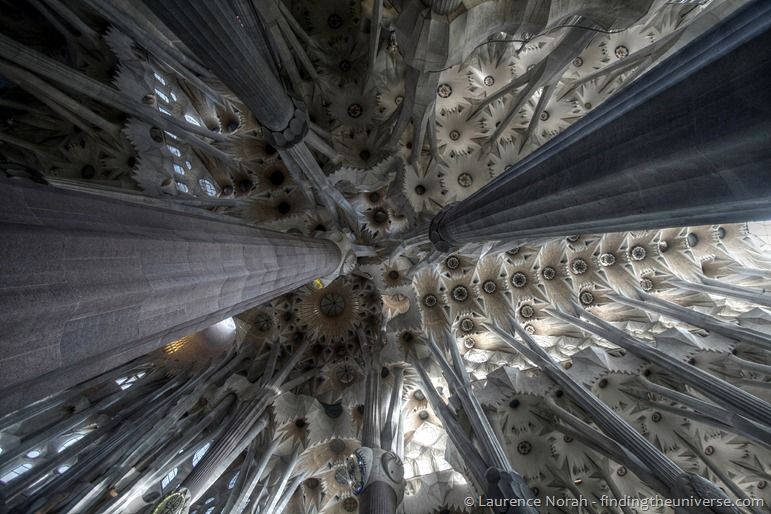
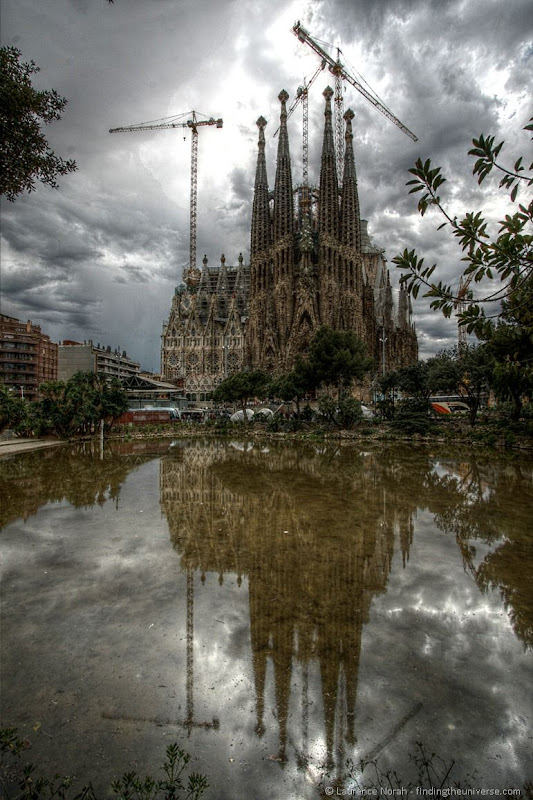
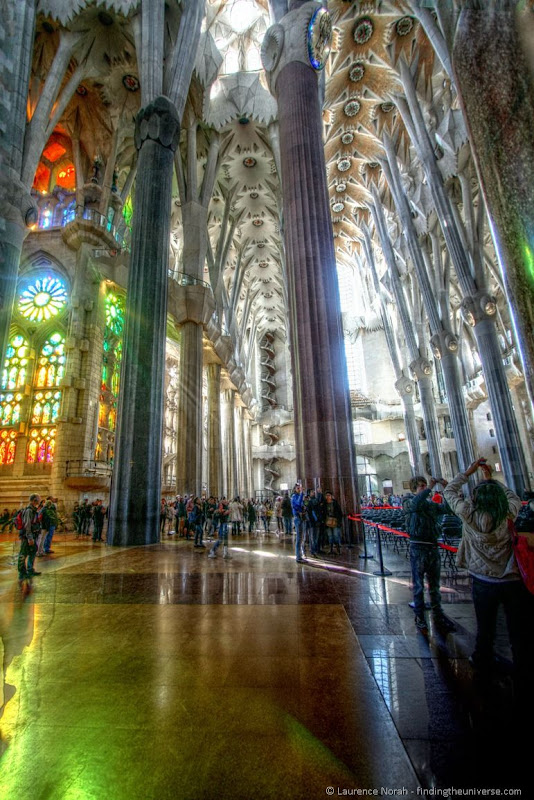
We might as well start at the top. The Sagrada Familia is Gaudí’s masterpiece, the building that obsessed him in the later years of his life, and which is still under construction. It’s an ever evolving masterpiece, an easily visible part of the Barcelona skyline, and one of the most incredible buildings I’ve ever visited. You cannot go to Barcelona without visiting it.
Parc Güell
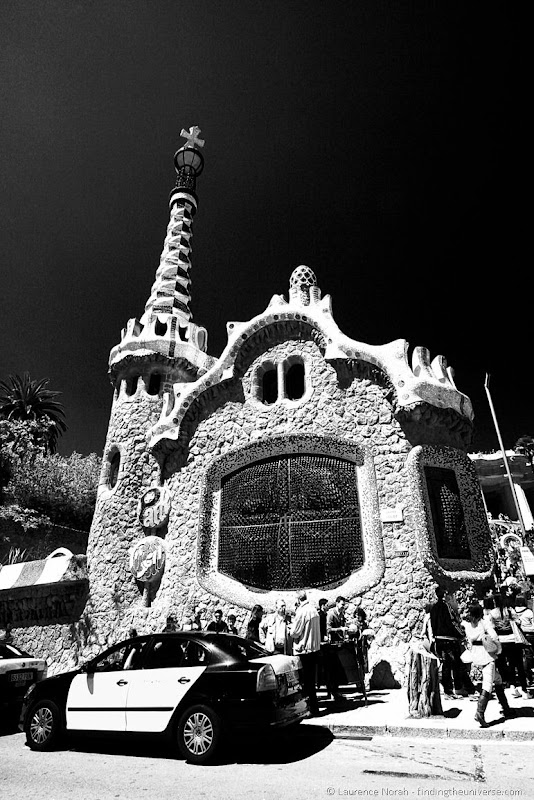
Parc Güell was Gaudí's attempt at creating a garden city development. I say attempt, because of the 60 buildings planned, only two were built, neither of which was actually designed by the man himself.
Instead, Gaudí spent his time focusing on the little details, like the enormous terrace. Gaudí also lived in the Parc for 20 years. These days, the garden is open to all, and is well worth the visit.
Casa Batlló
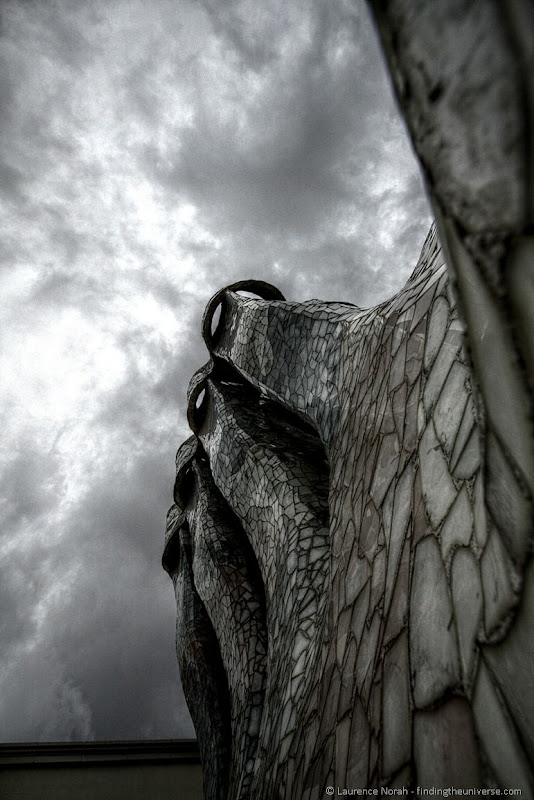
Casa Batlló, also known as the House of Bones, is one of the finer examples of a town house designed and built by Gaudí for a rich Catalan family. It is most well known for it’s striking exterior wall, made up of balconies which to my mind looked rather like the masks one would wear at a ball. Should one be invited to a masked ball that is.
My favourite bit of the house was up on the roof, where what appeared to be the spine of a dragon was laid out as the roofline. I’m not sure it was a dragon, but given Barcelona’s close connection to St. George, I have hope.
Casa Mila, also known as La Pedrera
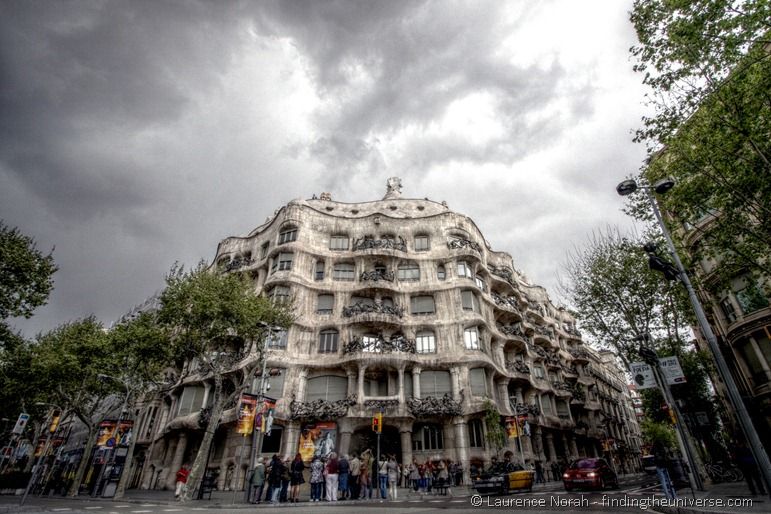
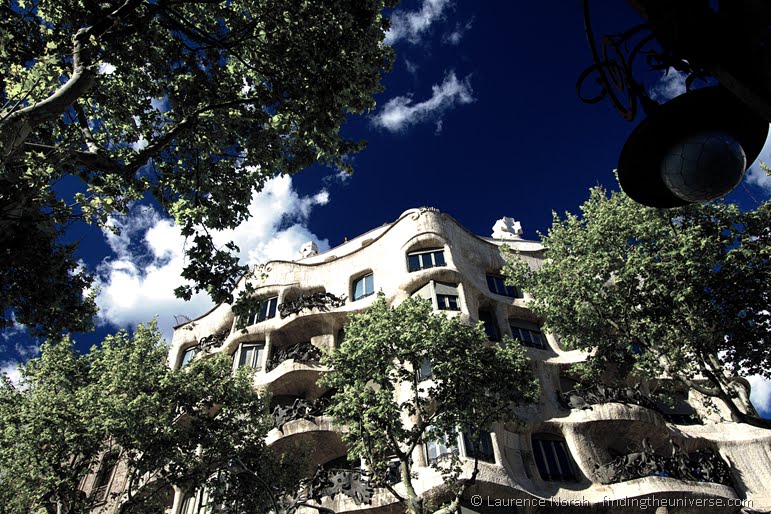
Not far from Casa Battlo is Gaudi’s other famous Barcelonian town house, the Casa Mila, which is known by pretty much everyone as La Pedrera, which translates as the Quarry. The locals at the time not being entirely enamoured of Gaudi’s style choice with the building.
As with the Casa Battlo, this was built for a wealthy family, and broke pretty much every planning rule in the book when it was put up. The price of great art in this case coming with plenty of building regulation fines, and rather irate owners.
Cascada in Parc de la Ciutadella
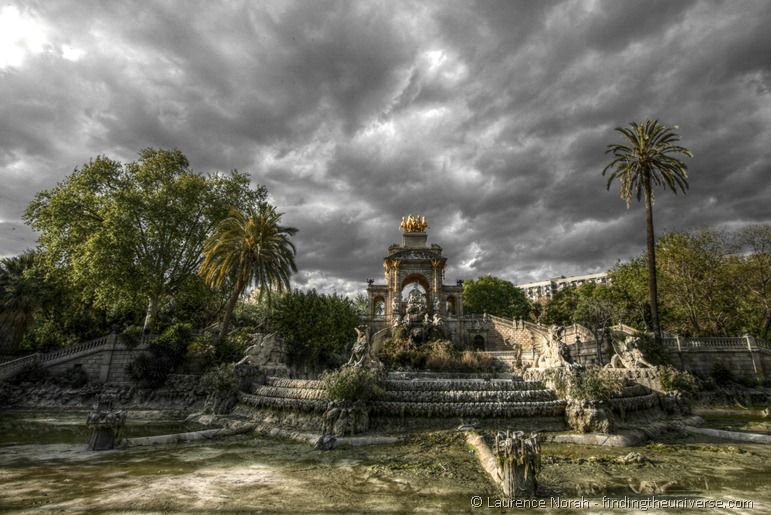
This fountain, in the pretty Parc de la Ciutadella, near Barcelona’s parliament building, was mostly erected by Josep Fontsere. It is understood that Gaudí did work on it, during his early student years. It’s nowhere near as organic as some of his later works, but is still a great looking bit of building! When we visited, it wasn’t in operation, and had a wonderful air of decay going on.
So there you have it. Five of my favourite bits of Gaudí work in photos. Obviously Gaudí left behind more than these pieces, and Barcelona is just stuffed with incredible architecture from people other than this great man. But for sheer madness, it’s hard to beat what he got up to! Let me know what you think of the photos, of Barcelona, or of life in general, in the comments below!
Also... don’t forget to check out my site’s facebook page, where I share lots more of my photos!
I’ve just spent a week visiting Barcelona. I’d like to say that I did a whole bunch of research before setting off, but to be honest, I’m not that great at research. For example, I managed to get through an entire University degree without stepping inside a University library.
Plus, I like a place to surprise me. I asked you guys for your tips, and you supplied them in plentiful fashion. Barcelona’s tourist board, who hosted me so splendidly on this trip, sent me over a whole bunch of stuff too.
But none of this meant that I really knew the following things. I was ignorant… now I am less so. Yay for travel!
Barcelonés, or Barcelonians, aren’t exactly Spanish
Ooh, I’ll start off with the contentious one first then. Sure, Barcelona is *in* Spain. But it is in the Catalan region of Spain, a region which has its own language, own culture and… if the local population had its way... its own borders.
A basic study of Spanish history probably would have helped me out here, but I was never that great at history, particularly after spending two very dry years of my teenage life studying in great depth the Russian revolution of 1917. Something about reading the account of peasants being tyrannised in a frozen wasteland just turned me off history.
So, whilst officially Barcelona is a part of Spain, there are hints everywhere, from flags to language, even to domain names ending in .cat rather than .es, that really, the locals consider themselves somewhat separate. I’m sure there’s a whole world of politics and history here that I could get bogged down in. Instead, let’s move onto other, less contentious and more tasty subjects.
Lunch is a somewhat lengthy affair
I’ve never really travelled in a country which has that Spanish themed approach to lunchtime. I thought the French took lunch breaks seriously, but they really can’t hold a candle to the Spanish.
Lunch time starts a bit later than I was used to (turning up before 1pm raised eyebrows.. try that in France and you’ll be lucky if they still have a plat du jour left), and runs.. well.. until dinner time as far as I could see.
The other thing is that the traditional concept of starters and main courses isn’t the standard here. Possibly because tapas is so popular. Instead, meals consist of two slightly smaller main courses, followed by dessert and coffee.
Food is also incredibly cheap, by Western European standards anyway. It’s not hard to find a meal that includes first and second dishes, dessert, coffee and a beverage, for under 10 euros. No wonder everyone eats out all the time!
Barcelona is a seriously popular destination
I had a vague hope, when planning my trip for early April, that i would be able to miss the peak visitor months of the summer, when visiting European cities is… well... a bit of a chore.
And, when we blearily stumbled off the train at 8am on a Saturday morning, the wonderfully deserted narrowly winding streets of the Gothic Quarter were reassuringly empty. We had Barcelona to ourselves!
Of course, the reality wasn’t entirely in line with this first impression. Pretty much any city is largely deserted at 8am on a Saturday morning. As the day wound on, and people started to wake up, it became rapidly apparent that Barcelona is an incredibly popular destination. The major sights were always crowded, as were the streets, restaurants and even the parks!
It wasn’t really a problem – a city is a place of people after all. It was just a little busier than I had imagined for April. Good news for the tourism economy though. I’ll be writing a post on my tips for surviving a European city in summer soon, although in the case of Barcelona, the tips will probably apply year round…
Barcelona is eminently walk-able!
One thing that really stood out about Barcelona, which isn’t always the case with large cities, is how easy it is to walk around.
Sure, there is an awesome public transport infrastructure, with all modes of transport offered, from trams to buses to a metro and even bicycles. But for me, the best way to experience a city is on foot, and Barcelona is a city that is just so wonderful to experience from the pavement.
It has distinctly separate districts, all of which have their own character and beauty. The aforementioned Gothic Quarter is all tiny maze like passageways framed by looming buildings.
There’s the gorgeous beach fronted Barceloneta. There’s the Eixample... full of beautiful art nouveau buildings in a modernist style. Something for everyone, and all just so easy to get between! A walkers haven.
St George is not an exclusively English Saint
For most of my life, being English, I have been living under the misguided impression that St. George was this English chap who slayed a dragon, saved a princess, and gave us a national day that we largely ignore.
Then I visited Barcelona, and discovered that St George is also the patron Saint of Catalonia. Some further research has indicated that he also happens to be the patron Saint of nine other countries, including Portugal and Germany, as well as four cities including Venice. This was a chap whose dragon slaying abilities clearly travelled well. He was also Turkish.
Unlike the English, for whom the St. George flag only really appears when we want to celebrate our football team being dire, the Catalonians really revere this guy. He appears all over the city in statues and artwork, and his national day is a seriously big deal. Poor old St. Valentine doesn’t get his own day in Catalonia – rather, St George’s day is the day to celebrate love. After all, what’s more romantic than a day celebrating a bit of princess saving and dragon slaying.
On St. George’s day, it is popular tradition for men to give women a red rose, which symbolises the blood of the poor slain dragon, and for women to give men a book, which symbolises knowledge. These days, what with women being allowed to read and everything, the exchange is more balanced, with everyone getting everything. Which seems fairer.
So that was some of what I learnt in Barcelona! More posts will be following on the subject of this wonderful city. In the meantime, if you’ve got stories to share about what you’ve learnt on your travels, or any feedback on this post, do hit up the comments below!




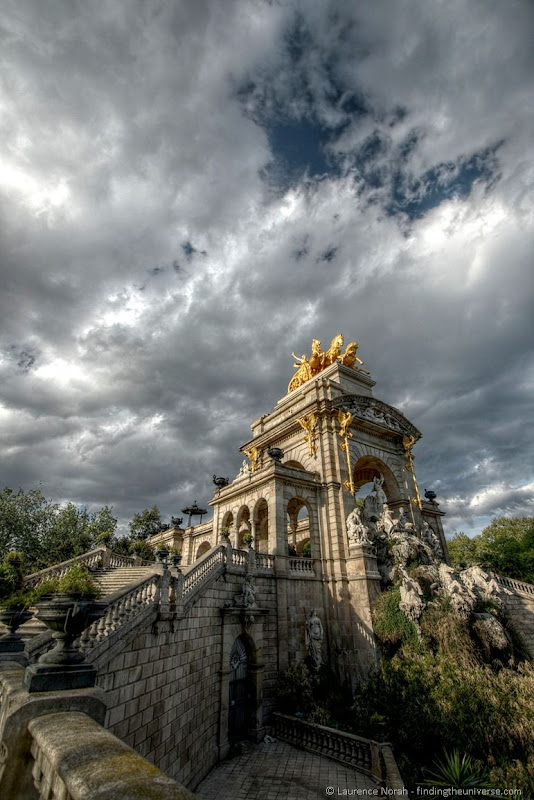 This fountain, in the pretty Parc de la Ciutadella, near Barcelona’s parliament building, was mostly erected by Josep Fontsere. It is understood that Gaudí did work on it, during his early student years. It’s nowhere near as organic as some of his later works, but is still a great looking bit of building! When we visited, it wasn’t in operation, and had a wonderful air of decay going on.