The drivel featured by TIME-Lightbox in relation to its magazine cover of Netanyahu is nausea-inducing on many levels.
But let's stay on what the cover seeks to tell us. In my view, it tries to tells us that Netanyahu's stare is that of a politician, tough, steely and unwavering...that line may perhaps get swallowed in New York City, but in Europe and the Middle East (yes, TIME magazine will feature the same covers on all its international editions), it'll be construed as a stare of arrogance, zealotry and defiance.
Then, it tells us that he's a "King"...presumably because he has "conquered" Israel by convincing the centrist Kadima Party to join a coalition...and then the cover uses Netanyahu's nickname as a baby (or whatever Bibi is). Is the purpose of infantilizing the name to familiarize him vis-a-vis the American public? Make him one of us...since we have the rather unfortunate habit of nicknaming everyone?
For crying out loud, the fellow's name is Binyamin Netanyahu...use it.
I've traveled to Bhutan no less than 5 times over the past 12 years, leading photo expeditions that were extremely popular and were well attended. These photo expeditions were especially enjoyable, provided its participants and myself a solid inventory of photographs of Bhutan's unique culture, traditions and religious festivals, and were trouble-free.
However, over my last three photo expeditions in 2006, 2008 and 2009 I noticed changes...some subtle and others not so subtle. Tourism had progressively become a huge business. The guides and fixers we had on these photo expeditions have become tour operators themselves, luxury hotels chains (such as the Aman Resorts with already 5 properties in the country...Thimpu, Paro, Gangtey, Punakha and Bumthang, with the Taj and Uma chains) are building properties, and there's now a domestic airport in central Bumthang for those who want to fly from Paro, instead of driving for a couple of days.
Shane Green, a photographer who's joining my forthcoming photo workshop in Vietnam, just returned from Bhutan along with his wife, and emailed me his impressions, and they confirm what I have sensed and noticed over the past few years.
Yes, Bhutan is still a wonderful country to visit, and the Bhutanese are some of the most gracious people one can hope to meet, however exploding consumerism, modernisation and urbanisation are taking their toll. Thimpu seems to be a huge building site, with many leaving their rural living to make a living in its capital.
In 2009, I recall having a cappuccino with a Thimpu resident in a Starbucks look-alike cafe and then playing snookers (and drinking too much beer) at a sort of watering hole with some of my group, amongst Bhutanese teenagers. And yet, a few days before, dinner in a Jakar hole-in-the-wall, consisted of Tibetan momos cooked the traditional way in a dingy smoky kitchen.
It wasn't too long ago that most, if not all, Bhutanese women had their hair in pageboy cuts, but with the advent of television bringing with it 46 channels exposing people to Indian (and others) programs, they started to grow it, following the Bollywood fashion.
Shane went as far as remote Ura, in the central Bhutan, where I don't recall seeing any tourists there as recently as 2009...and yet now, tourists outnumbered the local audience at its annual festival.
Is it over for Bhutan as a specialty destination? I hope not...but I don't see how its tourism authorities can retain the country's cachet against an encroaching modernism, especially with a population that seeks a more affluent standard of living brought about by tourists and other sources.
After all, look at what's happening in Siem Reap...and Angkor!
I predict it won't be long before the Ugyencholing elderly man in this post's photograph will be holding a Blackberry or a Nokia...if he doesn't have it already.
I've been asked as to how close (or far) this particularly fierce looking and menacing Oracle devotee was to me whilst I made this photograph. After all, he's wielding a ceremonial sword with a curved tip that seems to threaten my well-bring...and, depending on what lens I am using, could be inches or feet away from where I was.
This is one of the photographs I made during the festival of the Oracles of Kodungallur celebrated at the Bhagawati temple, which was one of the highlights of my Oracles of Kerala Photo Expedition-Workshop this past March. It involved the sacrifice of cocks and shedding of the Oracles own blood, to appease the goddess Kali and her demons who are said to relish blood offerings.
Well, I was inches away from him and was so close that I felt the draft or the swoosh made by the whirling of the sword above his head. My eye was glued to my viewfinder, shooting like crazy...and since I was using my 17-40mm f4.0 lens, set at probably 17mm.... I "saw" him at quite a safe distance.
Though he seemed rather out of it, I think he was still very aware of me...so I don't think I was in any danger despite the proximity.
But the moral of the story is that when one is photographing something like that, shoot with both eyes open! You'd avoid a splitting headache.
"...the lack of grace by the surly keepers of the Cheraman Juma Masjid was jarring..."
I can hardly be described as a critic of Islam, since I've always been constructively supportive of its world-class religious traditions and its admirable moral values, and of Muslims in general.
However, I must say I was spectacularly discomfited by the reception and attitude of the individuals involved in the Cheraman Juma Masjid; the oldest mosque in India and in Kerala's Kodugallur district. On one of the last days of my The Oracles of Kerala Photo Expedition/Workshop™, I decided to take my group to visit and photograph this historical mosque.
We were coming from an indescribable "high" from photographing the Bharaini festival of the Oracles, (not too far away from the mosque itself) for two solid days, and where we had been welcomed by the excitable crowds of worshippers, helped by self-appointed guides, and always smiled at. Not once was I (or to my knowledge, anyone else in our group) treated brusquely or rudely.
Not so at the venerable mosque.
I was brusquely gestured at by the security guard to go to an empty office...directive that I ignored. He wasn't pleased, and was nonplussed when I asked him if he was a Muslim. He wasn't, and the question stunned him long enough for me to continue walking towards the mosque itself....leaving him scratching his head.
The women in our group wore the required head scarves, but were prohibited from entering the main hall of the mosque, and shunted to a dingy side room where there was nothing to see.
Our driver, a Muslim himself, was roughly scolded by a couple of Islamic scholars who were passing through because he was removing his shoes where he shouldn't have. Actually, his "trespass" was about two inches in.
Now, here's my take on this. The Cheraman Juma Masjid is the oldest mosque in India and worthy of pilgrimages and visits by Muslims and non-Muslims for its venerable history and status. It's also in dire need of donations and of funding. One would think that the peptic keepers of this moque would exude charm, hospitality and proffer a welcome mat to all visitors alike...in the hope of donations.
But no. Quite the opposite.
So here's what I would tell the keepers of this mosque, and beyond. Fatimah, the favorite daughter of the Prophet of Islam, prayed alongside him in Mecca. His wife, Khadija, was a self made business woman. To treat women of whatever persuasion as inferior is anti-Islamic and in direct contradiction to the actions and values of the Prophet himself. They can disagree all they want...they can risk a collective apoplexy...but that's the truth.
Here's what I would tell the two scholars who chided our driver. I would tell them that God is all forgiving, and it would have been more in keeping with Islamic traditions to be gentle if someone made an unintended mistake. And minding their own business would be even better, since it would avoid having others like me chiding them for wearing unkept beards, and lecturing them on real Islamic values.
How could I explain to the members of my group why we were welcomed with no discrimination at Hindu religious gatherings, but faced with surliness and boorish behavior at the Cheraman Juma Masjid?
I couldn't.
So the question of this post is pertinent. Will these delightful young boys who were so pleased to see us, and excitedly pose for us at the nearby Islamic medresa, change when they get older? Will they also be surly and unwelcoming to non Muslims?
That's when Leica will announce a "whole range of product launches" in Berlin. Am I waiting with bated breath for these new products? Not at all. But having a M9 and very much aware of its strong points and shortcomings, I'm interested in seeing what will Leica come up with. It's more from a business side than from a photographic one since the German company is under assault from Fuji and others that are treading on its turf.
I was recently sent a heads up by Zeyad Gohary on a new all-white $31,770 M9-P model with a Noctilux f/0.95 50mm lens. Ridiculous of course, but perhaps it will sell well amongst the moneyed elites, celebrities and collectors. I had a chuckle imagining it in my grubby hands had I had one and used it during the recent festivals I was at in India. It would have turned black (with yellow turmeric and red stains) very quickly. Maybe the Kardashian sisters and their ilk would buy it, but Leica must've done its market research and concluded that it'll make money peddling this all-white model.
That said, I wonder what a "whole range of product launches" will mean. It's reported that the Fuji X-100 clobbered Leica's X1 model, and I predict that Fuji X-Pro 1 will become a favored tool for photographers who won't shell out $8000 or so to buy a M9 (or more in case of a successor). Leica is run by hard headed businessmen who look at the bottom line, and hopefully look into the future...and the future is for cameras that look, smell, cost and work like the Fuji X-Pro 1. Leica's investors know the future as well, and making white M9-P is a cute gimmick, but will not bring in the kind of cash inflow that satisfies these investors.
The range of new products may mean a successor to the M9, lenses and -if my gut feel is right- a new line of mirrorless cameras to directly compete with the Japanese products. A new M10 (improved focus, better LCD, better ISO, etc) and/or a new range of EVIL-like cameras.
i've dropped my college for my passion of travelling ,writing n photography!
your work have quite inspired me continue it!
n just wanna thank you!
your blog is quite a source of inspiration for me!
thank you"
It's a leap year, and what better way to end this February's 29 days!
This wonderful email from a young Indian woman was waiting in my inbox...and while I frequently get complimentary emails on my photography and blog from readers, this one was so enthusiastic, and so full of hope for the future, that I had to feature it here.
Naturally, I urged her to remain in college, get a degree and pursue her passion at the same time. I hope she does.
I occasionally meet with young people seeking my advice as to how to forge a career in travel photography. It's always a difficult task to balance youthful aspirations and hard-core reality...but one of my principal pieces of advice is to stay in college (if they don't have a degree...and get one), and take up a profession that can pay the bills for a while.
Oh, what fun! I received one of "those" cheeky emails again. I get a few every month, but this one in particular prompted me to write a WTF? post. It's been awhile since I've written one...I don't want to get rusty.
So yes, I got an email from someone assisting a travel photographer (possibly well known, but one I've never heard of...not that means much anyway) who asked me to post a banner and a press release advertising this travel photographer's 2012 photo tours. Yes, you read that correctly...a banner!! A banner of the photographer's photos on my blog!!
There are a couple of rather obvious gigantic WTF?s here.
The first is that I am a travel photographer who creates, plans and leads photo workshops, so why would I want to advertise someone else's trips? Yes, my photo workshops are certainly different from many others, since my niche is in combining documentary photography with travel photography throwing multimedia coaching in the mix, and generic or other travel photography tours wouldn't be real competition, but what's in it for me? Nothing. And why would I endorse photo tours I know nothing of?
The second WTF? is that there was no indication that if I were to do this, I'd be compensated in any way. There was no request for my advertising rates for example, nor an offer to reciprocate the favor on the other photographer's website/blog. No, it's "just do it for free".
I replied, as politely as I could, saying I wouldn't do anything of the sort, explaining why using the simplest words in the English language.
This brings me to a larger question, and one that has been raised by other photographers who author popular blogs.
If I were to say that ad rates in photo magazines' and their websites are in the $500-3000 range, would I be far from the truth? I don't think so. Of course, rates depend on the size of the ad, frequency, color or B&W...but who reads print magazine these days? Not many, but many more read blogs...a lot more.
So why shouldn't individual popular bloggers expect and get similar revenue streams to advertise products and services? The Travel Photographer blog and other popular photography blogs reach a much larger segment of consumers than most photography magazines, and we are still played for suckers when it comes to adverts.
I've seen quite a few errors in the captions of photographs recently, but this one is probably the most misleading. The photograph appeared in the Pictures of the Week on the Denver Post Plog.
Underneath the photograph is a caption that reads "Eman Mohammed, 7, holds a placard that reads in Arabic, "our army is over our head, and the parliament belongs to the ousted," during a protest in Tahrir Square, in Cairo, Egypt, Monday, Jan. 23, 2012. The parliament elected in Egypt's first legislative vote after Hosni Mubarak's ouster nearly a year ago held its inaugural session on Monday, with Islamists dominating the 498-seat chamber that will oversee the drafting of a new constitution."
This is incorrect, and is at a 180 degrees divergence from what is on the placard. The correct translation of the Arabic words on the placard is "Our Army is over our head (ie a colloquialism for being held in great esteem)...The Council belongs (or follows) the ousted (for the ousted Mubarak)."
The Council referred to on the placard is not the Parliament, but is the Supreme Council of the Armed Forces. This is totally divergent from what the caption incorrectly states. The child is presumably one of the protestors who took part in a demonstration against the military council, not against the civilian Parliament.
I always wondered whether in such a case, would the error be that of the photographer (in this case, an Arabic speaker) or someone else?
I always write a post at this time of year to observe the annual anniversary/birthday of The Travel Photographer's blog. I've started the blog five years ago (in London actually, and probably only because I was stuck at home as it was raining) and since then, it attracted an astonishing number of readers and visitors.
On the poster above, I haven't added my 5400 followers on Lightbox, an Android app (and soon to be on iPhone too as well).
Over two million unique visitors! Two million!!!
It established itself as a blog to read amongst a certain segment of the photography industry, and earned me the attention of many photographers (pros, semi-pros and non pros), photo retailers and industry experts. Yes, it's time-consuming (much less so now because it's well known, and requests from photographers find their way to my inbox on a weekly basis), but I still have enough self discipline to attend to it on a daily basis (well, 99% of the time).
And one of the most pleasant thrills I experience is being accosted in public and asked if I was "The Travel Photographer"...and this happens not infrequently, especially in New York City. If I may say so, adopting the brand name "The Travel Photographer" is one of the best ideas I've had in years. A self-pat on the back for thinking of it. A lesson to the younger photographers: brand yourself!!!
Onwards towards the 6th year.
As they say in my country of birth...Insha' Allah!
It's a curious thing evolution. Not the kind of evolution that most Republican Presidential candidates unintelligently profess (or pretend to) not to believe in, but our own visual evolution...our visual maturation.
Last night, I was going through my photographs from the week I spent attending the Angkor Photo Festival in Siem Reap and, whilst I hadn't any plans to seriously photograph there, I nevertheless did manage to grab a few hundred of shots. I had no specific storyline or photo shoots in mind, played the tourist and just photographed whatever took my fancy.
I left my Canon 5D Mark II in my hotel room, and only used my M9 fitted with an Elmarit 28mm f2.8 during that week wherever I went, and it was liberating -but also challenging to some degree- to be using a rangefinder with only one lens.
Looking at my photographs, I isolated the four you see above this post that I believe illustrate the visual maturation I've been through since I started photography in earnest some 12 years ago. The top two are the shots I used to prefer almost exclusively during the first few years of my photographic trajectory...simple, uncomplicated, candid, pure travel photography....those I call perhaps undeservedly the "lazy" shots. Although these are made with a rangefinder and a wide-angle lens, I used to make similar photographs using a 70-200 lens, staying at some distance from my subjects. I no longer do this, especially with the gear I now prefer to use. That being said, this type of photography is currently my least favored. It's a milestone in my visual maturation.
The one of the caretaker monk at Wat Bo is a chiaroscuro portrait; the kind I like when making a simple "one-subject" photograph. It takes a little more planning and setting up, and is obviously much more dramatic than the "plain-vanilla" top two.
The bottom image is the type of photography that appeals to me the most at this stage. It's far from being a great photograph, but comparatively is more complex. It's not as multi-layered as a street photograph, and is just of dance performers dressing up for tourists at Angkor Wat...but is much more interesting than the above three; at least to my eyes.
A few years ago, when I definitely moved to digital photography, I decided -for space reasons- to cull my slides, and must've thrown out thousands of what -to my eyes then- were crappy shots. I only kept the "good" ones which are largely similar to the top two photographs...simple and uncomplicated. Who knows? Perhaps I threw a few slides that would have now been "keepers".
It's why I no longer trash any of my image files....unless they're really bad, really really blurry or beyond any fix. With digital files, physical space (as in filing cabinets or whatever) is no longer an issue, so all images are saved and archived....one day, they may be keepers after all!!
Fujifilm is emulating long standing Leica's marketing tactics by introducing the Black FujiFilm X100 Limited Edition which will be limited to only 10,000 cameras.
This slick and glistening dedicated website for the new X100 is designed to make us salivate at the prospect of spending $1700 for this "limited issue" model, which is a $500 premium over the regular model.
Leica is well known to make its products as desirable as possible...by giving these the allure of being limited or exclusive...and obviously charging for the privilege of owning one. The recent launching of the M9-P is a classic example of Leica's marketing tactics (or techniques, if you prefer).
While I consider a $500 premium excessive for what is essentially a paint-job, I leave it to its eventual the end users to decide whether it's worth it.
And here's a clincher thought: Fujifilm and Kodak were in the film-making business, and competitors. Why aren't we seeing Kodak digital cameras as exciting as those by Fujifilm?
The blogosphere is abuzz with the news that FujiFilm will be launching a new mirrorless camera soon, and its tech details were published in a French magazine as having a custom 16MP CMOS sensor, use Fujifilm’s EXR processor technology, feature a second-generation hybrid viewfinder, and will be available with 3 fast prime lenses (18mm f/2, 35mm f/1.4, and 60mm f/2.4). More details here.
"...the smart money ought to be on the new mirrorless cameras."
I certainly hope the rumors and the leaks are accurate, so we have more of the so-called “Micro Four-Thirds” and “EVIL” cameras such as the venerable Panasonic GF1 and the newer GX1. If the Fuji X1-Pro1 is indeed a reality, street photographers and others will be sorely tempted to buy it, certainly if its price point is reasonable. The French magazine article claims that its price in Europe (in Euros) will be equivalent to $1700 including a sweet 35mm f1.4. The remaining two lenses are said to be priced at the equivalent of $780 each. Since European prices are usually higher than those in the US, perhaps the street price here will be around $1400 (about the price of a Canon 7D body).
I am convinced the era of the bulky DSLRs will wane very soon, with the future belonging to theMicro Four-Thirds cameras, and certainly not for bulky cameras whose bodies were built for film transport, and have not changed since. Nikon and Canon can launch and hype their newest DSLRs until they're blue in the face, but the smart money ought to be on the new mirrorless cameras.
And that's why I will not be upgrading my Canon 5D Mark II nor my 7D. As for my question as whether the Fuji X1 being a threat to Leica...I think the answer might well be a qualified yes...and here's some more red meat for the naysayers... I still think Leica will come up with a mirrorless iteration at some point soon.
UPDATE: As Per Leica Rumors, It now appears that Fuji will release a Leica M-mount adapter for the X-Pro 1.
UPDATE 2 (January 8) Via Steve Huff: Amazon Taking Pre-Orders On The Fuji X1 Pro1 Lenses (but Not The Camera Yet)
UPDATE 3 (January 9) ViaPDN: Official Press Release And Specs For The Fuji X1-Pro1
Old Delhi is one of my favorite locations for street photography, and is a must stop for me when I'm in India for my photo expeditions/workshops.
I produced a short documentary audio slideshow on the Spice Porters of Khari Baoli of Old Delhi, but on my way through Chandni Chowk, I started photographing with my M9. While some of my photographs were made by shooting from the hip, most were not. Chandni Chowk, as any other market and public place in India, is a dream environment for street photography since it teems with living tableaus.
Notwithstanding, most photographers are bound to be noticed and stared at. Now, this is a problem because the essence of street photography, as told to me many years ago by Costa Manos, is that no one must see the photographer. In other words, if any subject in one's street picture is seen looking at the camera, the photographer has "failed" in capturing the moment. Perhaps extreme, and very difficult to achieve in India where people are alert, curious and have no problem at dropping what they're doing to stare at whatever and whoever interest them.
It takes a little more speed, sometimes stealth, and certainly patience to work around this. We all have our techniques, but I find that a lot patience and "fading in the background" works best. Eventually, the most curious loses interest and I have free rein in photographing as much as I care and need to.
Here are some examples of the street photography "obstacles" I faced during my latest trip in Chandni Chowk.
The top photograph is of someone I describe as "The Quizzical Guy". He saw me photographing, and just froze alongside some mannequins, and kept staring at me for a while...trying to figure out what I was doing. So I photographed him.
The middle photograph is of someone who's the exact opposite of The Quizzical Guy. He probably saw me photographing The Coco Seller, but didn't care and just walked through. If he didn't notice me, he's probably a rarity amongst the crowds of Chandni Chowk.
The bottom photograph is of the "Don't Photograph" fellow. The man had absolutely nothing to do with Khari Baoli, but thought he had authority of telling me not to photograph. I get this type of people quite often...and I tell them quite firmly they ought to move on and find something better to do. He must have been a retired police officer who missed his authority. He wagged his finger at me, and quickly left.
LightBox, the blog by TIME’s photo department, is one of my daily photography pilgrimage stops, and it ought to be yours as well. It has just compiled a 2011 yearbook, picking a photo for each day of the year.
Since I am always pleasantly surprised when I particularly like a photograph from various news sources and it subsequently wins an award of some sort, I will try my luck with the 365 photographs picked by the TIME photo editors. I have to say it was a tough call as the editors have done a really terrific job in choosing these photographs.
Nevertheless, out of these 365 photographs, I chose 5 that most appealed to me both from an aesthetic standpoint, and for the subject matter they cover.
My first choice is the November 22 photograph (shown above) of an Egyptian protester tossing a tear gas canister, which had been thrown by the riot police, during clashes near Tahrir Square in Cairo. The photograph is by Amr Abdallah Dalsh (Reuters). In my view, this photograph ought to garner many photojournalism awards.
My second choice is this magnificent image of September 9 by photographer Moises Saman of Libyan Eyadea Elspaie visiting the gravesite of his son, Tareq Elspaie, who was killed by Gaddafi loyalists in August. The sorrowful posture of this father, under a dramatic sky, is just a Biblical scene.
My third choice is the August 17 'penumbra' photograph by Abir Sultan-EPA of a Hasidic community member praying in a cave of an old Arab house in Lifta (Jerusalem), Israel. The man's stance in the darkness, and the shaft of light on the man's tallit or prayer shawl, may perhaps be interpreted in different ways, depending on one's political agenda. For me, its just a great picture.
My fourth choice is the October 19 photograph by Matt Dunham—AP of an Irish traveler in front of a burning barricade during evictions at the Dale Farm travelers site, near Basildon England, 30 miles east of London. This was a huge story in the United Kingdom, and being in London at the time, I recall that it was wall-to wall coverage of this rather localized issue. Here again, a very well composed Biblical scene. I also nod my head at the fact that the upper right hand corner was left untouched...even with what appears to be an electrical or telephone cable.
My fifth choice is the September 30 photograph of the OWS movement by Spencer Platt (Getty Images). The photograph is of a Wall Street protester from upstate New York, holding up a sign in New York City. I've seen many of the OWS photographs, and this one in particular resonated with me...perhaps because the protestor is masked by the poster? It was a faceless movement after all.
There they are...my five choices. Will any of these go on and win awards? We'll see.
I thought of ending 2011 with various "look-backs" and favorites that appeared on The Travel Photographer's blog.
1. Photo Expedition/Workshops:
I rate the Kolkata's Cult of Durga Photo Expedition/Workshop as the most logistically challenging, but also most rewarding from a documentary standpoint, of my photo expeditions. As I've written in previous posts, the participants (most had no prior knowledge of multimedia) produced highly commendable audio-slideshows during the two weeks spent in Kolkata.
My comprehensive verdict and epilogue of the Kolkata's Cult of Durga Photo Expedition/Workshop was published on October 28.
From the In Search of the Sufis of Gujarat Photo Expedition™, I produced my favorite audio-slideshow and photo essay The Possessed of Mira Datar. It documents the pilgrims who flock daily in their hundreds to the shrine of a renowned Sufi saint in Gujarat.
2. Favorite Photo Essay By Photojournalist:
There's no question that it was the terrific photo essay in The New York Times titled Cairo Undone by Moises Saman. It made me recalibrate my earlier thoughts about photographing in Cairo.
3. Favorite New York Street Photography Event:
In the early days of November, I ventured to Zuccotti Park in Lower Manhattan, and spent a few hours photographing the Occupy Wall Street movement. As I wrote in the blog post, I sympathize with most of the OWS positions. Some of the photographs I took are featured on The Leica File.
4. Favorite Photo Festivals:
I'm not a big photo festival goer, so I only attended two in 2011...but I thoroughly enjoyed participating in the biannual Delhi Photo Festival in October (regrettably for only one day), and attending the annual Angkor Photo Festivalin Siem Reap. Both of these festivals were extremely well organized and the attendance was phenomenal!
5. Favorite Photojournalism Workshop:
The Foundry Photojournalism Workshop is my hands-down favorite. Not only because I'm one of the faculty members, but because it's really fantastic. The photographers in the faculty generously share their knowledge and time, its staff, administrators and local volunteers make it wonderful successes year after year, and simply said, the participating photographers "students" are the future...and it's personally rewarding to be part of this.
6. Favorite Short Vimeo Movies:
I loved Miehina, The Kyoto Geisha by Glen Milner. Extremely well produced, and instrumental in shaming me in not having visited Japan yet.
Carolyn Beller takes that one with her The Mississippi Delta photo essay, which I imagined viewing with a song by Howlin' Wolf or John Lee Hooker (as only two examples) blaring in the background.
8. (My Very Own) Favorite Prediction:
No one takes my prediction seriously (at least publicly) but I predict the advent of a mirror-less Leica...a $3500 Micro Four Thirds Leica. I know it's wishful thinking, but that's what my Nostradamus crystal ball tells me when I look in it.
And another of my silly predictions was that I'd never take pictures with an iPhone. Yes, I do now.
9. Favorite Love-Hate Relationship:
I have a love-hate relationship with my Leica M9...many photographers share this emotional dichotomy. I imagined it would not last as long, but it has. I love the M9's handling, heft and durability and abhor its shortcomings...and yes, it makes really great pictures when I know what to do.
And my Dumber Than Dumb moment of 2011 is when I exhausted myself polishing my Elmarit 28mm lens because the view through my just acquired M9's viewfinder was smudgy. The more I polished the more it got smudgier...of course, I was polishing the lens with my thumb squarely on the viewfinder window....a rangefinder newbie brain fart.
The most popular post on The Travel Photographer during 2011 is a POV titled Is Shooting From The Hip Photography?. Many many thousands of views on that one. Wow!
And here he is...Tim Allen is the The Travel Photographer's favorite travel photographer of 2011. Tim is is a English photographer with a hefty professional background, who has won prestigious awards. He has worked with indigenous communities throughout the world , most extensively in India and South East Asia.
I've meaning to address this question for a while now, especially as I seem to have entered a monochromatic phase in my own photographic evolution. With a couple of exceptions, all the photo essays I produced over the past 18 months have been in black & white...those of Bali, the one of tango in Buenos Aires, and those of Gujarat...all black & white.
"Participants will merge their still photography and audio to create compelling narratives. While black & white photography may lend itself better in the context of this particular workshop, it is left to each participant to decide on whether to produce narratives in color or monochrome."
My reasoning behind this recommendation was straightforward. I insisted in having the participating photographers focus their photography purely on the documentary narrative rather than being seduced (and distracted) by the powerful colors of India, of Kolkata and of the Durga Puja in particular. I also wanted the participants to capture the rawness of what they photographed...not embellished by the bells and whistles of color.
In that, I succeeded. The participants' projects were all very well edited and produced, and were focused on the rituals of the event, with no splashes of color to divert the viewers' attention from the going-ons. Yes, the garlands of marigold were gray in their audio slideshows instead of brilliant yellow, the women's vermillion powder was also gray...but this didn't diminish the power of their visual narratives.
My own recent Khari Baoli: Old Delhi's Spice Bazaar audio slideshow was shot in color but produced in monochrome; a decision that was difficult to make because -as seen from the one of its still photographs (above) - the yellows of the turmeric burlap sacks, the purple of the porter's head cloth along with the various degrees of whites and grays of the scene, all make it much more seducing to the senses than its monochromatic version. So should I have opted for color instead?
No...because my intention in the audio slideshow was not to 'seduce' with colors but to do so with the grittiness and edginess of the monochrome...the same rationale I followed in suggesting monochrome during the Kolkata workshop.
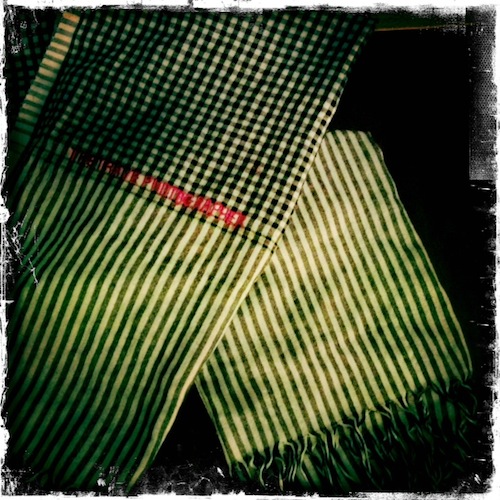
While in Siem Reap, I dropped by the Old Market and stocked up on traditional Khmer scarves with the intention of having them embroidered with The Travel Photographer logo, and making a fortune selling them online.
While having lunch at The Soup Dragon, I showed the manager my The Travel Photographer's pouch that had that logo, and asked if he knew of a store that could duplicate it...and indeed he did! Scribbling the name and address of the place in Khmer on a scrap of paper, he said it wasn't too far from the restaurant, and that it was just opposite a secondary school which used it to embroider its tshirts etc. Perfect!
I hired a tuk-tuk driver (Chen, who was to remain as my driver for the duration of my stay) and we went looking for the embroidery shop. I expected to see a computer-driven embroidery machine, but all I saw was an electric sewing machine and a woman who assured me (through Chen) that she could duplicate the logo quite easily. I wrote it down in my best capitalized handwriting, gave her my old krama for a trial run and was told to return in 20 minutes. Perfect!
Spending these ensuing 20 minutes thinking of having all my stack of kramas embroidered with my logo, returning to the US and selling them online at a monumental profit, was very enjoyable. However, these dreams of untold riches came tumbling down when I was returned my old krama with the logo as you can see from the above photographs...the L in Travel was deemed superfluous by the semastress and I got The Trave Photographer instead.
The poor woman was mortified and tried to convince me she could fix the error...but I just laughed it off. Yes, my get-rich-quick scheme collapsed because of a dropped letter. The moral of the story is this: make sure your outsourcing contractor can write English.
That being said, the mistake on this scarf (especially as it has been worn for a number of years) could well make it very valuable. As an example, the mistakenly inverted Jenny stamp was auctioned for $1 million!
I was greatly impressed by the Angkor Photo Festival's evenings at the FCC, and by the quality of the curating. As I mentioned in previous posts, both Francoise Callier and Jean-Yves Navel were instrumental in making a success of the event, while tireless Camille Plante and Jessica Lim made it tick. However, this is not the main purpose of this POV post.
It's been the third time I'd been in Siem Reap and to the temples of Angkor, and I am chagrined that, while Siem Reap itself still has traces of a bohemian feel to it, despite the high number of tourists invading its bars and restaurants, its temples have lost their mystique due to exuberant commercialization.
For example, both the Angkor Wat and the Bayon temple in particular are overwhelmed by hordes of tourists. The tour buses disgorge Vietnamese, Japanese, Korean and Chinese tourists by the thousands each day. This not only mars the aesthetic of these temples, but also has long term negative effects on the integrity of these historic monuments. The lay nuns all clad in white robes who could be found in some areas of Angkor Wat and the Bayon are now gone, replaced by men in Western shirts and trousers who sell incense sticks to tourists. To add insult to injury, there are now groups of students who dress up in apsara costumes, and who clumsily pose for pictures with tourists (see above picture). I assume these changes are approved and "endorsed" by the Siem Reap police and tourist authorities.
In my view, the Angkor Wat temple complex experience has deteriorated over the past 5 years. Both the influx of tourists and the need to maximize revenues from this world heritage site by the Cambodian authorities are the causes for this deterioration. If any of my readers haven't visited the Angkor Wat temple complex, I advise you to go as soon as possible and perhaps choose to do so when it's off-season (monsoon season may be an intelligent choice).
If and when you do, forgo the many established restaurants for dinner and try an area where there are lots of outdoor restaurants specializing in Khmer barbecue (BBQ Lover is one), and sample the grilled squid, giant prawns and fried morning glory. The area is opposite The Red Piano and is between Street 11 and Street 8. You won't regret it.
How wrong I was! I always dismissed the idea of photographing street life in Cairo by saying that there was nothing to photograph there...not much color, no vibrancy....but that began to change after the January Revolution. Was it a subconscious rejection of the then-prevailing environment? Or simply because I was blase about photographing in my own backyard...albeit one that I left for more than 30 years? Was it both? Perhaps.
That admission being made, I have to clarify that I speak only of street life rather than particular cultural subject matters, such as documenting Sufi rituals such as those I photographed a few years ago.
What changed my mind is the brilliant photo essay in The New York Times titled Cairo Undone by Moises Saman. The photo essay (it's really a gallery as there's no storyline nor timeline) is of snapshots (I use this term very respectfully) of daily life in Cairo...the gritty, the edgy, the incomprehensible, the political and the anachronisms that dominate this teeming city.
I intended to post this as soon as I saw the photographs, but I was in Siem Reap and just couldn't find the time. I have viewed and re-viewed this work many times, and it revived in me a hunger to document facets of this city. Is it a nostalgic yearning? I doubt it...I don't think that way. It's similar to my documenting the Sufi rituals in various countries...that is nothing more than an intellectual and aesthetic pursuit.
It's the same for Cairo...nothing more nothing less. But time will tell.