Related Posts Plugin for WordPress, Blogger...
Showing posts with label Peru. Show all posts

Friday, December 23, 2011

The Ashaninka: Mike Goldwater

Photo © Mike Goldwater-All Rights Reserved
In Focus, the photo blog of The Atlantic magazine, featured The Ashaninka, A Threatened Way of Life; photographs by Mike Goldwater. Be sure to view the photographs in the 1280px option if your monitor allows it.

The Ashaninka are an indigenous people living in the rain forests of Peru and in the State of Acre of Brazil, and are one of the largest indigenous groups in South America. Their number is estimated between 25,000 and 45,000.

Current threats are from oil companies, drug traffickers, colonists, illegal lumberers, illegal roads, conservation groups, missionary groups, and diseases. Roads are being built into the forest to extract mahogany and cedar trees for export to markets in the United States and Europe despite an international embargo. Religious missionary groups are intent on changing Ashaninka culture and belief systems, ignoring the impact on their long term survival.

Mike Goldwater is a photographer, who ran the Half Moon Gallery in London's East End from 1974 to 1980, and who created the magazine "Camerawork". He also co-founded photo agency 'Network Photographers' for photojournalism, documentary photography and corporate work.  He traveled to over 70 countries and his images were published in major magazines around the world.

You may also wish to see Tatiana Cardeal's work on South American indigenous people.

Friday, April 15, 2011

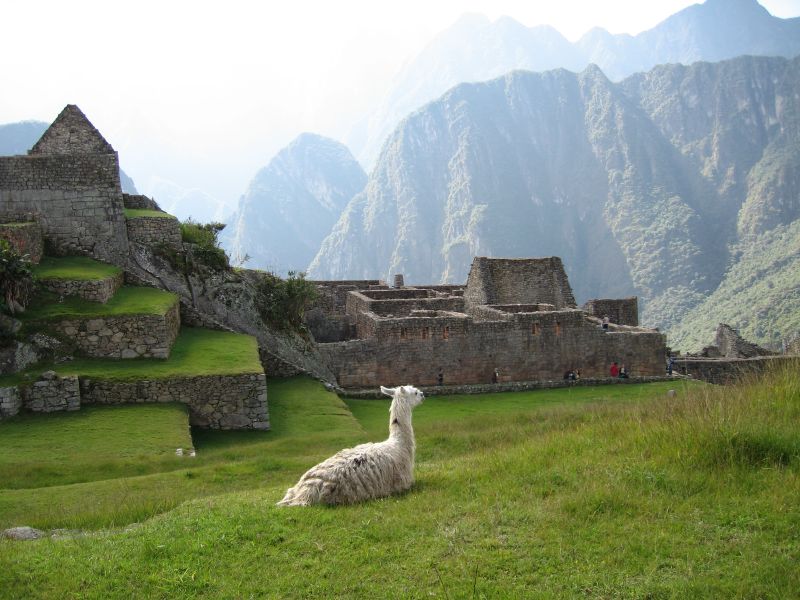
Machu Picchu, Peru - Tips for Hiking and Climbing Preparation

Thanks Sachin for this article about Machu Picchu. Definitively a place where everyone should try to go at least once. Cradle to the vast Incan Empire, the largest city in pre-Colombian America will leave you feeling inspired. Next, Sachin's experience and tips for beginner climbers and hikers.

When you are planning a camping trip overseas, there is a little more to do than just book your transport and sign-off your cost effective and cheap travel insurance. Camping, hiking and similar holidays get better as you get more experience. There are so many things to know and understand. A few days on the peaks of Machu Picchu, the home of the ancient Incas was a life changing experience. Here are the 'must-dos' of your attempt.

Machu Picchu, Peru
Time of Year - The dry season is April to November, and so this is the only time you can go. All good tour operators will advise the same.

Insurance - Always check with your supplier and make sure your policy will cover you for the particular activities. If you are going into the Amazon, you might not be covered. Make sure you understand all the requirements of your activities.

Machu Picchu City, Peru
Clothing - It is easy to make a mistake on this one. Preparing clothing that will cover you for all extremes of weather during the day and night that is light enough to carry when you are not wearing is essential. It is a good idea to wear boots well before you are going to use them in rough terrain. There is nothing worse than breaking them in, while you are half way up the mountainside.

Do some reading - It always pays to read up on the destination before you go. Read more than descriptions, search for stories and reviews by previous travellers. Look for real-case advice. Those who have been, will have a tip or two that will make all the difference.

Machu Picchu View, Peru
Talk with others - If you are staying in a backpackers in Lima before you leave for your final destination, talk with other travellers, and get some last minute personal advice. It will not be hard to find someone who has been, or has just come back. There is nothing like talking to someone else who has been.

Think about altitude - Understanding the effects of altitude takes some experience. None of us really understand the implications of altitude. This is another area to research. This is also one of those things, until you have experienced it for yourself, you will not really understand. Everyone reacts differently, and the way you feel can change in an instant. Being aware of your mental state and your physical condition takes some practice.

Machu Picchu Lama, Peru
Tour and Guide - Even the most experienced travelers should arrange for a local guide to take them into well-known regions. Local guides have many years of experience with the local conditions. This may also be a requirement of your travel insurance. This is an absolute must.

Make a checklist - With so much going on, it is easy to forget a single item that will impact your whole trip. Writing a checklist, and working through that on your final departure day is essential.

Machu Picchu City Walls, Peru
Understanding diet - When you are climbing through jungle, or hiking up hills, your body will use a lot more energy than normal. Getting a good grasp of how much energy and what kinds of foods are good for you, and how much you need to eat, will make each day of effort that much easier. You will need certain foods to keep your body warm, and others to give you energy for the effort. Get some education on this.

Even those who are not often physically active can change the way they live with regular outdoor holidays. Spectacular mountain views and surreal surroundings are also beneficial for the mind. From someone who never experienced this type of travel, then tried it, I can tell you it is very addictive. The ancient buildings at Machu Picchu are a wonderful place to begin your new hobby in outdoor adventure.


Again thank you Sachin and also a big thanks for the photos to the Ocean's Art site.

Thursday, June 10, 2010

John Batdorff II: Peru


It runs in the family, as they say.

John Batdorff II is the son of two avid photographers, and it was only natural that he was "infected by" the same passion. Based in Chicago and in Ennis (Montana), John developed his craft early on by photographing for his family's newspaper, and enhanced it by specializing in landscape and travel photography.

His work has been exhibited in museums and featured in various publications.

While John's galleries include one of India, I'm bucking my own trend this time and featuring his work of Peru.

Thursday, September 17, 2009

NPR: Traveling Down The Amazon


Here's Traveling Down The Amazon, an intelligently produced NPR multimedia feature that combines audio, stills and graphics to tell the story of transcontinental highway being built in Peru and Brazil which promises to bring economic opportunities, and also acute environmental problems, to one of the most remote places on earth.

NPR correspondent Lourdes Garcia-Navarro and staff photographer John Poole traveled the Peruvian route to produce this series.

I found this via a Twitter post (aka a "tweet") by Tracy Boyer, the editor of the excellent Innovative Interactivity blog, that deals with new multimedia and which she appropriately calls "a digital watering hole for multimedia enthusiasts".

Traveling Down The Amazon is not the kind of feature that one can watch in one sitting...it's too long and too dense to absorb in one go. So bookmark it for whenever you have the time to follow it properly.

I haven't had the time to watch except the first chapter The Road, and found it surprising that the producers of the piece haven't sync'ed the stills and the narration by Garcia-Navarro together. It hasn't bothered me much because I could return or go forward to the still photograph I was interested in, and still keep the narration going on.

Thursday, July 2, 2009

Kamil Bialous: Ayacucho Procession

Here's the work of Kamil Bialous, a Toronto-based adventure travel photographer who describes himself as laid-back, but a "go-with-the-flow" kind of person. Out of his multi-facets portfolio, I chose his photographs of the Semana Santa in Ayacucho, Peru.

Semana Santa in Ayacucho is a celebration of Easter Holy Week festivities unlike anywhere else in the world, and these photographs made on April 10, 2009 showcase the emotional procession around Ayacucho's Plaza de Armas.

Wednesday, December 10, 2008

Moises Saman: Machu Picchu

Photograph © Moises Saman-All Rights Reserved

I noticed that The New York Times' featured a slideshow of Machu Picchu's photographs by Moises Saman, who's better known as a conflict photographer, having covered the Israeli-Palestinian conflict, as well as the wars in Afghanistan and Iraq.

The slideshow is titled The Lost City of the Incas while the accompanying article is written by Simon Romero.

The article's premise is that while Hiram Bingham (a model for the fictional Indiana Jones) has always been credited with discovering the Incan city of Machu Picchu in 1911, evidence has emerged that a German adventurer may have preceded him. Some records show that the German adventurer bought land in the area in the 1860s. It's an interesting read for those who feel (like I do) that many countries' heritage and patrimony have been pillaged by colonizing Western powers (especially European). For instance, I read that Ethiopia is now demanding that Britain’s museums return some of its most significant religious treasures and artifacts, including the Ethiopian royal crown, 140 years after they were looted by marauding British troops.

As for Moises Saman, he became a staff photographer at New York Newsday from 2000-07, and is currently a freelance photographer based in Brooklyn, New York. His work received many awards and recognitions, including in the 2007 World Press Photo contest and the UNICEF Photo of the Year awards. He also received a World Press Photo award for his coverage of the presidential elections in Haiti, as well as being named Photographer of the Year by the New York Press Photographers Association.

Wednesday, January 2, 2008

NY Times: Medicine Hunter

Image ©Jennifer Szymaszek/New York Times - All Rights Reserved

The New York Times seems to have recently enhanced its multimedia features available through its website. These appear to be better edited (except for some of its "fluff" travel slideshows) and are more interesting both visually and content-wise. Let's hope this continues since it provides creative opportunities and avenues to photojournalists and photographers.

A recent multimedia feature is on the efforts of an ethnobotanist who calls himself the Medicine Hunter and about his quest in Peru to study indigenous medicinal plants. His goal is for people to use safer medicine, and by that he means plant medicine.

In Peru, he is studying maca, a small root vegetable that grows in the country's central highlands. He describes it as “a turnip that packs a punch. It imparts energy, sex drive and stamina like nothing else.”

If this is true, the maca will catch like wildfire in the United States, where about 36% of all adults ingest some form of complementary and alternative medicine. The baby boomer generation will provide an enthusiastic target market for the enterprising companies that will make maca pills.

The photographs are by Jennifer Szymaszek, who also recorded the audio. Note to photographers: start learning (and start using) audio recording techniques as soon as you can, if you haven't done so already.

NY Times' Multimedia Feature: Medicine Hunter in Peru

NY Times' Article: On a Remote Path to Cures

Saturday, December 8, 2007

Atacama Desert: Multimedia


Here's a lovely combination of photography, audio, interactive maps, and design in a multimedia package that will inspire all of us who see this type of media as being one of the inevitable next steps in photojournalism....and in editorial or documentary travel photography.

It centers on the Atacama Desert in northern Chile, which is the driest place on earth. Stretching 600 miles from Peru's southern border, there are parts where rainfall has never been recorded. However the Atacama is also home to more than a million people who find refuge in coastal cities, mining camps and oasis towns. There are vibrant communities, artisans, toughened workers and a devoted group of astronomers taking advantage of this unique environment.

It's really too long to view in one sitting as it's a comprehensive study of the Atacama desert, so I started off with the section on the people...always the more interesting. The main backing for the project is from the Institute for Science Learning, University of North Carolina at Chapel Hill.

Atacama Desert

Wednesday, September 19, 2007

Ashok Sinha: Peru

Image Copyright © Ashok Sinha-All Rights Reserved

For a change in pace from yesterday's post: Ashok Sinha is an emerging travel photographer who was born in Calcutta and is now based in New York City. He works primarily on travel/tourism related assignments, and has traveled around the world on such assignments. Most of his portfolio on his website is of intensely colorful photographs of Mexico, Peru and India.

Ashok's photographs have a commerical slant to them, and I expect that they are generally aimed at travel and tourism clients, magazines and brochures. For instance, the one above of the Peruvian woman walking on a cobblestoned street is compositionally ready for a double page spread in a travel magazine...with the title of the feature printed on its right hand side. His website has other examples of this type of composition...especially those of India.

Ashok Sinha .

Monday, June 25, 2007

Miami Herald: Latin American Hip Hop

Image Copyright © Noelle Theard-All Rights Reserved

The Miami Herald just produced a brilliant multimedia feature on the hip-hop culture in Bolivia, Colombia, Ecuador, Peru and Venezuela. The feature is part of a larger many-layered and equally brilliant feature titled A Rising Voice: Afro-Latin Americans which examines social and racial tensions in Nicaragua, Cuba, Honduras (just listen to the beat of the Garifuna music!), Dominican Republic and Brazil.

The Latin American Hip Hop feature is a Soundslides production, with the photographs of Noelle Theard, a Miami-based photojournalist, whose talented lenswork and great sense of color/movement allows us to enter the hip hop world in these Latin American countries. The able narration is by Alvaro Cuello who describes for us how hip-hop creates a cultural bond above race and social class.

A highly recommended multimedia feature, here's Miami Herald's Latin American Hip Hop.

Noelle Theard's website is here

Monday, March 19, 2007

Sebastián Belaustegui: Guardians of Time

Image Copyright Sebastián Belaustegui

Sebastián Belaustegui was born in 1969 and although from Argentine, is currently living in Tepoztlan, Mexico. He has been an independent documentary photographer since 1991, and dedicates himself to photographing the native world of Latin America.

Sebastián’s work is exquisite, and can be seen in his gorgeous book Guardianes del Tiempo (Guardians of Time), which group his photographs of indigenous peoples of Central and Latin America. My favorite is of a Peruvian couple sitting in their room, a hamster peeking at the photographer between their legs.

His photographs appeared in National Geographic, Camera Art, Planet, and Gatopardo, as well as in newspapers such as the Los Angeles Times and the Sunday Times.

His website is here, and I urge you to visit his Personal Work section and his Guardians of Time gallery. I expect his book is available at bookstores.

 
Bloggers - Meet Millions of Bloggers