Related Posts Plugin for WordPress, Blogger...
Showing posts with label Italy. Show all posts

Thursday, April 12, 2012

My favourite bits of Venice

Venice Bridge and Boats

Venice recently won the battle for my favourite city in Europe, after a tense battle between four other serious contenders.

So far, though, it has been seriously lacking its very own personalised post about it, treatment that cities like Rome and Paris have already received. Poor old Venice. Fear not – I haven’t forgotten you!

Venice is a city that just captures my imagination in a way that few other cities are capable of. It’s a maze of tiny streets, a collection of islands linked by bridges and waterways, and the whole thing is possibly going to sink one day. There is art, music, architecture and food.

Most importantly of all, perhaps, the whole place is pedestrianized, what with there being no roads capable of fitting a car on. Seriously awesome for someone who loves to get to know a place by foot, like me.

So. When I’m in Venice… what do I get up to?

Visit St. Mark’s Square

St. Mark’s square, or Piazza San Marco, is an absolute must for any visit to Venice. In fact, one of my most enduring travel memories is having the whole square to myself during an immense thunderstorm, when everyone (including the pigeons!) scurried for cover, and I didn’t. I ended up somewhat wet, but happy.

St Marks Square Venice.png

The Square is home to a number of sights that are worth taking some time to look at. First, I’d highly recommend getting your legs into shape with a quick scoot up the Campanile di San Marco – the large bell tower at the corner of the square.

This will afford you with quite splendid views across Venice, and the surrounding lagoon and islands. The orientation probably won’t save you from getting hopelessly lost down the many back streets, but it’s great for taking some panoramic photos all the same.

Back down at ground level, you’ll want to take in the Basilica di San Marco. This is one of the most famous churches in Venice, and it’s also handily free, which is a rarity in this town.

Around the Piazza there are also a great number of museums and other churches. Entry to these is not normally free, although you can save money by buying a ticket that gets you access to multiple venues, if that is your thing.

View from the top of Campanile di San Marco Venice 2.png

Otherwise, the square is also home to a number of cafes, many of which have live orchestral music. You’ll pay handsomely for the privilege, but sitting in this square listening to classic music and enjoying a cup of fine Italian coffee is an experience that everyone should have at least once in their life. Apologise to your wallet later!

Explore the innumerable back streets

Venice has a lot going for it, with churches, museums and incredible bits of architecture literally jumping out at you on every corner.

The other thing that Venice has is a lot of people. The funny thing though, is that most visitors seem to stick to the main street that takes you on a big loop past all the main highlights.

Backstreets and waterways of Venice.png

If you duck off the main streets, as I usually do, you will find yourself in a maze of back alleys. I’d advise abandoning the map and just giving up on trying to maintain any sense of direction – just wander freely and lost. Venice is, after all, an island, and you won’t be lost forever.

You will, however, be rewarded with a side of Venice that is often overlooked and far less busy than the main thoroughfares. And then you will realise why Venice is my favourite city in Europe.

Head out to the other islands

The most well known part of Venice is the central area made up 118 islands. But there are more parts of Venice that are worth a visit. The four islands of Burano are well worth a visit, a fact that is corroborated with wonderful pictures by Ayngelina of Bacon is Magic on her blog post on Burano.
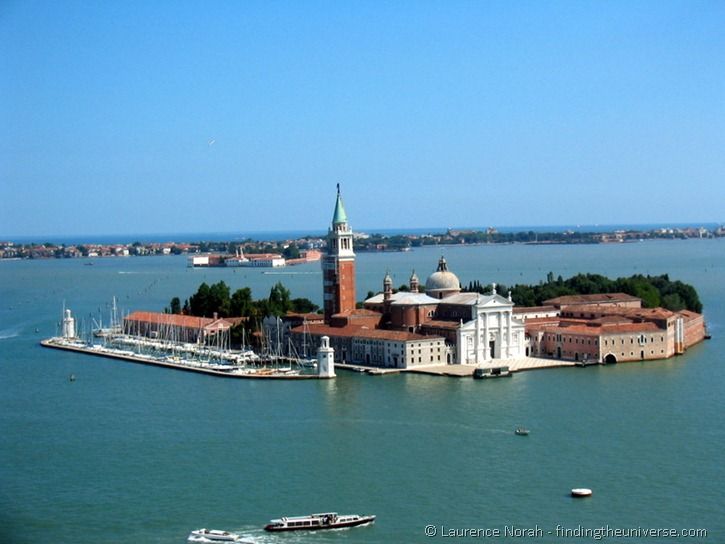
Island off Venice

There are many more islands, including Murano and Torcello. My point is – don’t forget that Venice extends beyond the central area that you will first come upon, and has plenty of opportunities for exploring! Don’t be afraid to jump on a boat and get out there… which brings me to my next point…

Take a boat ride

Now then. Venice is a city of waterways, and no visit to Venice is really complete without a trip on some form of water borne transportation.

If you’re travelling with your significant other, and your idea of heaven is a gentle meander down the back waterways of Venice, just the two of you, luxuriating on some pillows while a muscle bound man serenades you.. well.. you’ll sure be able to find an experience approximating that.

Although, as with the coffee in St. Mark’s Square, it’s an experience you best keep secret from your savings account.

If you’re not overly romantic, and you just want to experience Venice from the water, singing be damned, then you have no shortage of options. If your heart is set on a gondola, then you can take a gondola taxi from one side of the river to the other. It’ll be over quickly, but as least you can tick the gondola box.
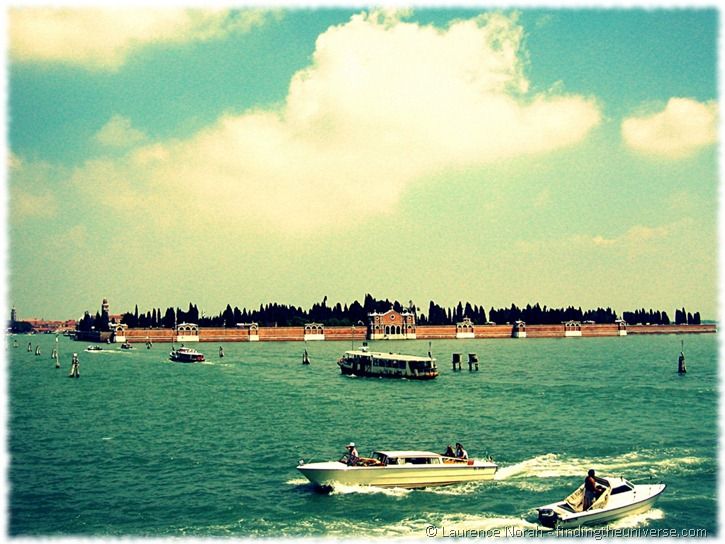
Venetian waterways and boats on lagoon

Alternatively, there are water taxis, water buses, and water sight seeing tours. Take everything you would normally find on a road, imagine it on the water, and you will find it in Venice. Whichever one you do, you’ll be sure to enjoy it!

When to go and other practicalities

Venice gets very warm (and very crowded!) in the summer months, although you can escape the crowds by hitting the back streets. My preferred time to visit would be the quieter shoulder months, when it is a little cooler and likely to be less busy. Although this is a tourist town, so don’t expect to be on your own whichever time of year you choose to visit.

If you want to visit the churches, remember that it’s common practice for there to be a dress code, which usually means no short skirts or bare shoulders. You don’t want to be turned away after queuing for a long time, so make sure you are dressed appropriately!

If you are planning a trip to Venice, don’t forget to check out Teletext Holidays for deals. I remember their TV campaign well.. you wouldn’t want to miss a bargain. There are regular flights to Venice airport from all over Europe, and you can also get here by train, bus.. or car!

Venice Panorama

So - have I sold you on Venice? Do you think it belongs up there as my favourite European city? Or are you firmly entrenched in the camp of people who believe that it’s a tacky, overpriced, overflowing tourist trap that just smells awful in summer? Hit up the comments below and let me know!

Tuesday, February 7, 2012

Christopher Thomas: Venice In Solitude

Photo © Christopher Thomas-All Rights Reserved

Today's post is at 180 degrees divergence from the one yesterday, as it features the beauty of the La Serenissima or the Most Serene; term that was applied to the Republic of Venice. I believe its Carnavale (its most internationally known festival) will be celebrated in less than two weeks, and is a perfect time to feature the phenomenally beautiful photography of Christopher Thomas.

Christopher Thomas is based in Munich, and graduated from the Bavarian State Teaching Institute for Photography. He works internationally as a renowned advertising photographer., while his photojournalism for Geo, Stern, Süddeutsche Zeitung Magazin, Merian, and other magazines received many international prizes.

His atmospheric photographs of Venice are currently on show at the Hamiltons Gallery in London, which I walk past often when I'm there. Unfortunately, I will not be in London during the exhibition which ends on February 27, so I have to content myself with viewing these online.

It appears that Christopher would set at the crack of dawn with a large format camera, lenses, a tripod and boxes of Polaroid Type 55 to make his photographs.

Christopher has also photographed in Nepal and Ethiopia, amongst other places, so visit his website.

Other websites with his work is the BBC In Pictures and Ira Stehmann.

Wednesday, February 1, 2012

Face off: five European cities duel to the death

Cities of Europe Collage

I was going to write a nice post about my five favourite cities in Europe, but then I figured that wasn’t quite as exciting as putting them to the test in a knockout and seeing which came up trumps. Naturally, this will be an entirely objective post, based solely on fact.

Each round will feature two European cities, and I’ll work out which one I like better, allowing it to proceed to the next round. The city still standing at the end, wins! Let’s get this started with our five contenders. Rocky theme music is optional.

Round 1: Paris vs Rome!

Montmartre Cathedral

Lets see – two cities famous for being the romance capital of Europe. Sadly only one can carry that particular crown, and Paris wins my heart there.

Romance isn’t everything though. Rome has the upper hand when it comes to empire building, with the Roman Empire once spreading all across Europe. They’ve also got the religious angle down pretty well, what with being the seat of Christianity.

As far as old crumbliness and prettiness go – well, Rome and Paris both have their spectacles, but for me, Rome wins. Paris may have a steel tower, but Rome has so many ruins that you can often find ruins built on top of other ruins built on top of other ruins. Rome is the onion of ruins. Plus the ice cream is better. Victory to Rome!

Round 2: Berlin vs London!

Berlin Reichstag

On second thoughts, putting Berlin up against London may have been an error, what with the recent history between the Germans and the English. Still, I’ll labour on, and do my best not to mention any unfortunate football based incidents.

I am slightly biased, as I lived in London for a couple of years, and haven’t spent a massive amount of time in Berlin. Still, the time I did spend there let me see what a fascinating city it is.

There are visible reminders of the cold war all around – from the crumbling remnants of the actual Berlin wall to the incredible street art to be found all over the city.

It is also home to a vibrant club scene, wonderful palaces and churches, and some of the most inventive sausage sauces out there.

It’s not all over for London though. London has quirky markets, incredible pubs, and some of the most recognisable landmarks in the world. Plus I’m English. Victory to London!

Semi-final: London vs Rome!

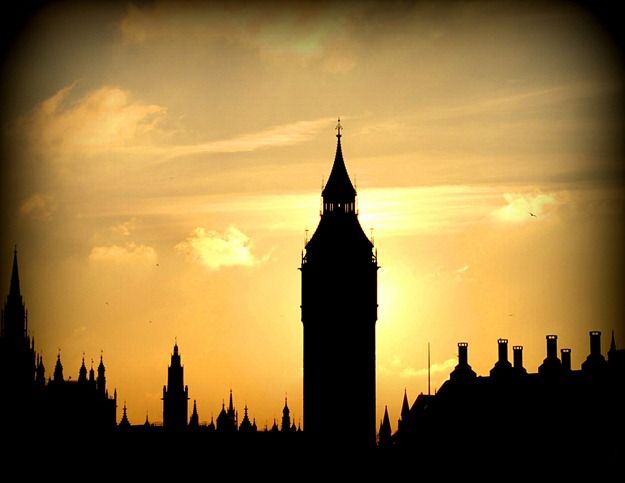
London skyline.png

So now I have two cities that are over two thousand years old, both of which owe a rather great deal of their look and feel to that previously mentioned empire, both of which I absolutely love.

Rome has some serious quirkiness going for it, which I am mostly basing on the fact that everyone drives tiny cars or scooters. This transport option is less popular in London, largely due to the presence of the deadly London bus.

Rome also has better weather, better ice cream, and a bit more crumbliness. London has markets that service goat curry, pubs that serve real, meaty beer, and the South Bank.

Ah, this was a tough one, but ultimately, London isn’t going to win this bout. Rome, as she was a couple of thousand years ago, is victorious. Alea iacta est.

Final: Surprise Contender vs Rome!

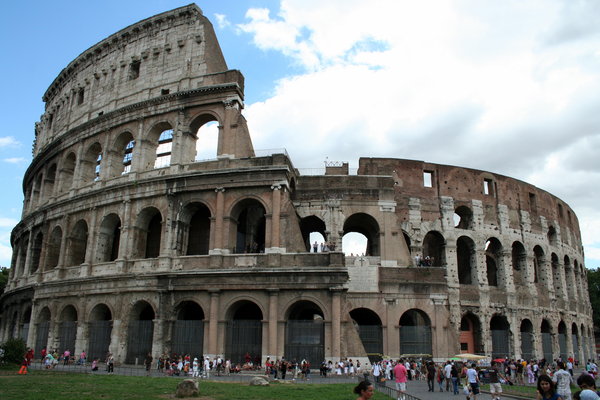
Coliseum Black and White

I did say this was a round up of five of my favourite European cities, and thus far only four have slugged it out, Rome emerging victorious.

My fifth city is a bit like Marmite. For those of you not familiar with this food stuff, marmite is a yeast based tar like substance that you spread on bread. The flavour is difficult to describe, and hard to appreciate unless you’ve been brought up on the stuff. The thing about Marmite though, is that you either absolutely love it, or you hate it. There is no happy in-between.

And the same can be said of Venice. Some folk absolutely adore the place, a city set in a swamp which is slowly sinking away. They will go on about the tiny backstreets, the magnificent piazzas and the fabulous ice cream. They will wax lyrical about the cafes, the glass sculptors, and the joy of getting lost in the pedestrian heaven that is a car free city.

Venice

Venice’s detractors, on the other hand, will bemoan that the place is tacky, full of tourists, overpriced, and smells like an open sewer.

Those people are wrong.

Which is why I am happy to declare Venice my overall favourite city in Europe! Rome has a lot to offer, but the magic that can be found in Venice is unbeatable.

I’d love to know what you have to say about my five picks! Did I miss one of your favourite cities off the list? Am I completely insane to have picked Venice? Share away in the comments below! And if you are planning on visiting some of these cities, why not check out the deals that Hotels4U have on accommodation, including London hotels and Paris hotels :)

Friday, December 16, 2011

My favourite bits of Rome

Vatican Roof

Now that I’m back in Europe, I’m looking forward to exploring all that this amazing continent has to offer, from local French attractions, to more distant jewels.

Having spent time touring in a country where the distance between towns was measured in driving days rather than hours, my perspective on the scale of Europe has now changed, so what once seemed far, is now a mere hop skip and jump away.

There are parts of Europe that I am lucky enough to already be very familiar with, with Italy being near the top of that list. Her capital, Rome, is a veritable travellers paradise, with endless options for exploration, from churches, to crypts, to crumbling relics of bygone empires. Today I thought I would share some of my personal highlights of Rome with you.

Before I plunge in, one point of note. Rome is an incredible city, but be warned, you’ll be sharing it with a whole bunch of other folks. The must-see’s though are must-see for a reason – it’s hard to find this much history and culture stuffed into such a small area in many other places.

So get your tourist vibe on, load your camera with film, and take the billionth photo of the Coliseum. Then load up on gelato by the Spanish Steps. By the end of your time in Rome, you’ll more than deserve it!

Central Rome

Vatican City

Whatever your religious views, the Vatican City in central Rome is one of those places that you really can’t visit Rome without seeing. As well as being the seat of Christianity, this place is home to some of mankind’s most famous pieces of art, including Michelangelo's David, and the Sistine Chapel.

Vatican City

You could spend days just wandering around this labyrinthine city within a city, but my number one tip would be to get above it all by taking the walk up to the top of St Peters dome for unbeatable views across Rome. Worth the climb.

The Coliseum

There is perhaps no more recognisable Italian structure in the world than the coliseum, where early Christians were thrown to the lions, and gladiators battled to the sound of crowds baying for blood. People talk about the place holding a great sense of history and the smell of fear – on the occasions I’ve visited I’ve largely just noticed people posing with “centurions” and reliving scenes from Ridley Scott’s Gladiator.

Coliseum Interior

The structure however is just boggling, made all the more astounding given the fact that it has been standing in Rome since 80AD. Nearly two thousand years in fact. It is the largest amphitheatre that the Roman Empire built, and has to be seen to be believed.

The Pantheon, and other central must-see items

The Pantheon is one of my favourite buildings in Rome. Its original incarnation was even older than the Coliseum, although that was destroyed by fire. It is particularly remarkable for its enormous dome like ceiling, famous for having a hole known as the occulus at it’s apex, through which the building is lit.

When I visited, for some reason, Led Zeppelin’s song Stairway to Heaven was playing through a tiny speaker under a statue of the Virgin Mary, a memory that has always stayed with me.

Trevi Fountain

Around the Pantheon, since you are there, are some other highlights of Rome that you should take the time to see.

The Trevi fountain, for example, is one of the worlds most famous fountains. It is traditional to throw a coin into this fountain, and roughly 3,000 euros a day makes its way into the waters. 

Also in this area are the Spanish Steps, famous for their people watching options, especially over an ice cream. If it’s a sunny day, you’ll probably want to take a break from all the ancient exploring, and get to grips with some of Italy’s famous Gelato.

Slightly outside Rome

If you get time to explore beyond the immediate central attractions of Rome, there is again no shortage of awesome places to visit. A couple of my favourites are:

The Baths of Caracalla

The baths at Caracalla are one of my favourite places in Rome. I think what gets me about the place is just the crazy obsession the Romans had with bathing, and the process that they created around that, which resulted in vast complexes like this.

Baths of Caracalla

Sprawling over 25 hectares, these baths were built in the 2nd century AD, and operated for four centuries.  When operational they could accommodate around 1500 bathers at any one time, although walking around the gigantic ruins, you’d think that most of the Roman population could turn up and have a wash quite easily.

There are of course, examples of mosaics and statues to peer at as well, but really, just walking around the grounds is an incredible experience. If you’ve got time, this is one I definitely recommend adding to your to-do list.

The Catacombs.

If you’ve visited the coliseum, and seen where the Christians got fed to the lions, you should continue your travels through Rome’s slightly ghoulish tourist attractions, and head to the catacombs, where Rome’s dead were buried.

With over sixty catacombs to choose from in Rome, you won’t struggle to find a spooky underground cemetery to get your ghoul on. Perhaps the most famous though, would be those found along the Via Appia, or Appian Way. These are the ones I’ve visited, and do require a short bus ride out of Rome, but this is an entirely worthwhile bit of effort.

The Appian Way

There is nothing quite like descending underground into dark musty corridors lined with ancient graves, dating as far back as 150 AD. The experience is claustrophobic and unnerving, a bit like being returned to the grave prematurely. And as with so much in Rome, absolutely worth doing.

And that’s that for today’s post on Rome! Have you visited Rome? Got a tip to share for a must-see attraction, or favourite place to while away a few hours? Do share in the comments below!

If you are visiting Rome, and looking for somewhere to stay, why not consider an apartment. These are often cheaper than a hotel, yet offer a far more private experience than your average hostel. Back in my days as a consultant, before I threw dreams of 100 hour weeks aside, I’d usually stay in self catered apartments instead of hotels if I could. Check out Rome apartments to rent for more details and pricing.

Sunday, December 4, 2011

Venice By FKY


For a complete change of pace this Sunday, I feature a wonderful short movie on Venice produced by FKY, presumably a French videographer from Nantes.

What hooked me to watch this movie was the opening song by Charles Aznavour "Que C'est Triste Venise"...a romantic but sad song whose lyrics start:

Que c'est triste Venise,
Au temps des amours mortes,
Que c'est triste Venise,
Quand on ne s'aime plus.
Charles Aznavour is is an Armenian singer, songwriter, actor and a public activist. He's one of France's most popular and enduring singers, is known for a gravelly voice and is also one of the best-known singers in the world.

The camera used in the movie is the Canon 5D Mark II with Canon 50mm f/1.4, 100mm f/2.8L - 24-105mm f/4L  and the 70-300mm f4-5.6L lenses with a Rode Videomic pro.

Monday, November 21, 2011

Colosseum, the Ultimate Arena, Rome, Italy

And here I am back to The Eternal City, Rome, my absolute favorite European capital. Wherever you go in the city it's difficult to make more than a few hundred meters without arriving at some fabulous monument. From the Roman period to the Renaissance, from the Middle Ages to the XXI century, the city is home to several structures of incalculable architectonic and artistic value.

Colosseum, Rome, Italy
Also in favor of Rome's tourism is the fact that, although the city's cost of life is far from being the cheapest in the old Continent, it isn't that hard to find good places to stay at reasonable prices. Just one tip, if you wish to find the best deals on hotels don't limit your search to travel agencies, search the internet too. Also keep in mind that being flexible on the dates of departure and arrival (checking in/out on weekdays) is always a plus when searching for good rates and discounts :)

Colosseum Outer Circle, Rome, Italy
Back to the city itself allow me to take you on a tour to the fabulous Roman Colosseum. The enormous circular stone structure built around the year 70 a.C. is almost 50 meters high and, although damaged by earthquakes and plundered several times over the years, it still maintains it's inner circle almost intact and a good part of it's outer walls. Along with the Roman Forum, the Colosseum ruins are still today one of the major symbols of the old Roman Empire and, of course, the most famous landmark of Rome.

Colosseum Arena, Rome, Italy
Inside the building one can still go upstairs and see what's left of the old spectators stands and access corridors and stairways. Bellow the ground, the catacombs and training complexes where the Gladiators stayed before the fights are also worthy of a look. On the ground floor, in order to help recreate the original scenario, part of the arena in front of what used to be the Imperial stand was reconstructed. To get an idea of the atmosphere of the Colosseum just imagine that in it's days, above the arena, it had a capacity of 50.000 seated spectators.

Colosseum Walls, Rome, Italy
The almost unbelievable size of the Colosseum is very well shown in this last photo. Both the buildings in background and the people in the streets nearby seem amazingly small don't they? Needless to say, Rome's most important must visit spot :)

Last but not least, a big thanks to OpenGalleries.org for yet another set of beautiful photos from Rome.

Thursday, November 10, 2011

Ruben Salvadori: Tales Of A Ritual


Warning: Some Brief Scenes Are Graphic.

A village in the Southern Italian region of the Calabria region is the backdrop for an ancient ritual that is claimed to represent a people’s identity; an identity that struggles to keep its tradition unaltered through time.
"Tradition is the pump that pushes the blood of identity".
During the Holy Week prior the Easter celebrations, the village experiences an intense spiritual and practical preparation for a weekend ritual. The statue of the Virgin Mary is taken out from its shrine to take part in the ritual of Vattienti. These are flagellants who beat their legs with two pieces of cork, one of which has 13 fragments of glass in it,  and represent the sufferings of Jesus, and who must endure the pain of religious mortification in the name of spiritual cleansing.

Ruben Salvadori is an Italian photographer, whose biography tells us that he's to graduate with dual majors for a BA in International Relations and Anthropology/Sociology from the Hebrew University of Jerusalem. He uses photography as an academic aid for his anthropological research, and mixes his academic background with a visual documentary-style approach to gain in-depth, empirical research results through his images.

Further information on the Vattienti:

This sacred popular custom centres around two figures; the “Ecce Homo” and the “Vattiente”, barefoot and tied to one another with a rope about two and a half metres long. The first wraps a cloth around his hips and holds a cross made of wooden slats covered in red bandages, as a symbol of blood and martyrdom; the other wears a black shirt with black shorts and a crown of barbed thorns on his head. Once they are dressed, the “Vattienti” rub and slap their calves and thighs with the “rosa”, a cork disk soaked in a warm rosemary infusion, in order to make the blood rise to their capillaries. They then use the “cardo”, another cork disk with 13 glass shards embedded in it, to beat the reddened parts of their skin. Rivulets of blood run down their legs, while red wine is poured onto their wounds to disinfect them and prevent fast clotting. Once they have marked the door of their house and those of their friends and relatives, as a token of good luck, each Vattiente goes to meet the Madonna Addolorata. This is the final climax of the rite when the flagellation reaches its height and becomes even more agitated and dramatic. (From Tour Calabria).

Saturday, October 22, 2011

Scuba diving and snorkelling in the Mediterranean

And thanks to Jess Spate for this list of some of the best scuba spots on the Mediterranean. A big thanks also to Jess's boss for allowing the use of the photos in this guest post :)

Almost anywhere you go along the coast of the Mediterranean sea, there are places to get into the water and find out what lies beneath the surface. Spain, France, Italy, Greece, Egypt- each country has something unique to offer under the sea as well as on the land. Here are just a few of the finest diving destinations around the Med:


Portofino, Italy - Less than an hour's drive from the grand old city of Genoa, the Marine Reserve at Portofino provides the best diving and snorkelling in the Europe- at least, that's what the locals say! There is some pretty strong evidence to support their claims. The seabed off Portofino is carpeted with fields of red corals and sponges, which are home to a wide variety of rare and interesting marine wildlife. The largest submerged wreck in the world (the Amoco Milford Haven, more than 1000ft or 330m long) is just down the coast and the famous Christ of the Abyss statue stands tall, 55ft under the surface of San Fruttuoso Bay.

Paros, Greece - It's hard not to be seduced by the romance of underwater archaeology. What could be more exciting than swimming over the top of ancient stony walls and finding the traces of an ancient civilisation lying where they fell a thousand years ago or more? The island of Paros is probably the best place in the world for amateur divers and snorkelers to explorers to learn about underwater archaeology and to get involved with it. Those who have plenty of time can even take a course (including incredible field trips) from the Aegean Institute.


Malaga, Spain - Diving in Malaga's La Herradura area has one real advantage- the bays in this area are so sheltered that there is almost always somewhere calm to dive, even in poor weather. There are reefs to dive on and also open caves to explore. Octopus, eels, and large grouper are plentiful. Sardines shoal in huge numbers too. Those with sharp eyes should keep a close lookout for seahorses in the coral. The waters off Malaga are also frequented by the huge sunfish. The world's largest bony fish, these creatures can weight anything up to a metric ton. They're not considered dangerous to divers though.

Malta - A paradise for wreck divers! All kinds of shallow water wrecks can be explored in this part of the world, from tug boats that sank only a few years ago to relics from the Second World War. It's not just boats either- divers can explore what is left of a WWII bomber aircraft too. Advanced divers can even get down to an old submarine lying about 55m below the surface. In total there are more than 20 wrecks to dive around Malta and the islands of Comino and Gozo. Many of the wrecks still have their guns, torpedo tubes, propellers, and other details intact.

Those are just four dive destinations out of hundreds of choices, if not thousands, spread out across the Mediterranean. There is something for every diver, and for every snorkeler too- you don't have to be an expert. Dive schools and underwater tour operators have never been more popular. There is no shortage of help and guidance for underwater explorers.


Jess Spate is a keen amateur diver and lately she has been moving towards underwater photography but still loves to dive just to see what's down there.

Tuesday, March 8, 2011

Monte Cassino, A Secret Travel Gem, Italy

Thanks to Alex today it's back to Italy. After reading your post and seeing the pics you've sent it's on my list - for sure a vacation spot to visit one day this Monte Cassino - it looks splendid!

A Bit About Cassino - One of the most beautiful places I have been to is called Cassino in Italy. If you are looking for a cheap vacation, then look no further. It is probably the best secret in all of Italy. There are tons of places that tourists in Italy tend to head to. These places include Rome, Naples, Turin, Milan, Florence and so on. However, if you are looking for a local place where the food is authentic, the towns are rustic and the locals still appreciate tourists, then you have to check out Monte Cassino.

Monte Cassino Postcard Paradox, Italy
Monte Cassino is located almost in the middle of Italy. It is about an hour south of Rome and is easily accessible by train. Back in the 1940s, Monte Cassino was a choke hold for the allied advance and was faced with destruction. After the war, Cassino was invested in heavily by the US to replace the destroyed city and Monastery.

Some of the Amazing Attractions - The history alone would be enough to attract people to Cassino but there are tons of other things that would keep you busy for a weekend. As mentioned earlier in the post, Monte Cassino was attacked by the Allied forces. The Allies had to attack the giant mountain with a century old Monastery at the top. This monastery was destroyed during the war but was rebuilt and is now a wonderful attraction. It takes about fifteen minutes to reach the top of the mountain. However, once up there, you can see the entire courtryside for miles and you immediately understand why it was such a strategic point during the Second World War.

Monte Cassino Cemetery, Italy
Another great attraction are the World War Two cemeteries and museums. As you can tell, you should probably be a WW2 buff or at the very least a history buff to visit Monte Cassino. The cemeteries are beautified with flowers and wonderful sculptures and truly pays homage to those who lost their lives during the fight to free Cassino. There is an American, Polish, Indian and German cemetery in the surrounding areas which are all equally beautiful . The museum takes you through an interactive tour, which is guided as well, of the entire build up, conflict and resolution of the battle of Monte Cassino.

Rocchette Castle, Italy
For those that aren’t history buffs, there are tons of things to keep you busy. Other than the amazing shopping, the beautiful beach is only 30 minutes away by car. If that is too far, there is a water park only minutes away from the center of the town. This is truly arelaxing experience with beautifully quaint towns to visit every single day.

Wednesday, December 8, 2010

World's 10 best driving roads in the world

After the top 10 beaches of the world here's another guest post and photos from David - It's driving time today :)


There are some roads in the world that stand out from the crowd. Whether it’s the views, the terrain, the danger or the potential speeds that can be reached that make these roads stand out, anyone choosing to visit them will not be disappointed. This list brought to you by Moneysupermarket discusses 10 of these amazing routes and explains what makes each of them so special.


Great Ocean Road – Australia


Running along the south-eastern coast of Australia between the Victorian cities of Torquay and Warrnambool, the Great Ocean Road is a 160 mile stretch of road that was built by more than 3000 returning soldiers between the years of 1919 and 1932 as a memorial for the 60,000 Australians killed in World War 1. A scenic drive with spectacular coastline vistas, stunning rock formations and many other splendid sights including the Otways rainforest, the impressive views make this road undoubtedly one of the most inspiring in the world.


Great Ocean Road – Australia

Millau Viaduct – France


Opened in December 2004, the Millau Viaduct is the world’s tallest vehicular bridge. Designed by the French structural engineer Michel Virlogeux and British architect Norman Foster, the Millau Viaduct spans the river tarn which is near Millau in Southern France. The bridge’s tallest mast is 343m tall which is taller than the Eiffel Tower and nearly as tall as the Empire State Building and the views from the bridge are quite spectacular. In fact, the views are so good that when the bridge initially opened drivers would regularly stop on the hard shoulder to admire the landscape and the bridge itself.


Millau Viaduct – France

Transfagarasan Road – Romania


The most popular road in Romania with driving enthusiasts has to be the Transfagarasan Road and it’s easy to see why. Connecting the historic towns of Transylvania and Wallachia, this dramatic route reaches as high as 2,034 metres above sea level in some places and provides drivers with a real challenge. This winding road is dotted with steep hairpin turns, long S-curves, and sharp descents which is a big reason why drivers rate this road so highly. Constructed between the years of 1970 and 1974, the 90km stretch of road also has more tunnels and viaducts than any other road in Romania with the longest tunnel being 884 metres long. Due to its layout and altitude, weather dictates that the road is usually only open between June and early October.


Transfagarasan Road – Romania

Stelvio Pass – Italy


Regularly voted as the best driving road in the world due to its 60 hairpin bends and the fact that it is the highest paved mountain pass in the Eastern-Alps, the Stelvio Pass in Italy is a driving enthusiast’s paradise. Reaching 2757 metres altitude, it is the second highest mountain pass in the Alps, only 13 metres lower than the highest mountain pass in the Alps. The road was built between 1820 and 1825 and has changed very little since then. The northern side of the pass is far more challenging with 48 of the hairpin bends located on this side. The steep ascents add to the excitement/terror as drivers often have little or no visibility of incoming vehicles.


Stelvio Pass – Italy

Overseas Highway – America


The 127.5 mile Overseas Highway in America was built back in 1938 following the Labor Day hurricane of 1935 that heavily damaged and partially destroyed the Overseas Railroad that had previously been in place. The route which is mainly over water runs from island to island across 42 bridges and it arcs through the Florida Keys. If you drove the full route in one go it would take less than 4 hours but with so many great sights to take in like the ocean, mangrove vistas and fantastic sunrises and sunsets, the journey often takes visitors slightly longer!


Overseas Highway – America

Guoliang Tunnel Road – Japan


Located in the Taihang Mountains which are situated in the Henan Province of China, the Guoliang Tunnel Road was amazingly built by a group of villagers who raised money to buy the hammers and steel tools needed to build the tunnel. 13 villagers initially started the project which took around 5 years to complete and cost a number of villagers their lives. The tunnel itself was completed in 1977 and is 1.2km long, 5 metres tall and 4 metres wide. As you might imagine, the road is regarded as one of the most dangerous in the world but that doesn’t take away from the fact that the Guoliang Tunnel road is a stunningly beautiful scenic route.


Guoliang Tunnel Road – Japan

Hana Highway – Maui


Connecting the small town of Hana to the rest of Maui, the Hana Highway is a 60 mile stretch of road that is extremely popular with motorists. Firstly there are the waterfalls, beaches, ocean views, rainforest and other stunning natural sights that make this route so attractive to visitors. Then there is the road itself which has over 600 turns, 54 one-lane bridges, blind bends and narrow pavement edged by cliffs which make this route one of the most thrilling in the world. Together, these two things make this road stand out as one of the must visit routes for car enthusiasts.


Hana Highway – Maui

Autobahn – Germany


If you were to look at the Autobahn you might struggle to see what all of the fuss is about. Just like highways around the world, Autobahns have multiple lanes of traffic heading in each direction which are divided by a central barrier. However, in many ways the Autobahns are the ultimate road for driving fans. The reason for this is that parts of the German Autobahns have no speed limit (except at junctions and various danger points) which means that motorists are free to drive as fast as they want. Obviously this is a hugely attractive proposition to motoring fans, meaning that the German Autobahn had to be included on this list.


Autobahn – Germany

North Yungas Road – Bolivia


High in the Andes Mountains in Bolivia is the North Yungas Road. The road is also known as Death Road and it’s easy to see why when you see the figures relating deaths and injuries sustained whilst travelling on the road each year. On average, there is a fatal accident on the road every few weeks and there are also remains of numerous cars, lorries and buses at the bottom of the abyss which serve as a reminder of just how dangerous the road is. Built in the 1930’s, the road stretches 43 miles between La Paz and Coroico and has huge ascents and descents, extremely tight hairpins and very narrow passages. What really makes the road dangerous though are the vertical drops off the side of the road which in some places are more than 1,500 metres and there are no guardrails to prevent vehicles falling. The North Yungas Road certainly isn’t for the faint-hearted but it’s also this danger that attracts so many people to the road.


North Yungas Road – Bolivia

The Jebel Hafeet Mountain Road – UAE


This amazing road is located in the Jebel Hafeet Mountain and spans 7.3 miles, climbing over 1,200 metres along the way. The perfect road surface and 60 corners make this road unquestionably one of the best driving roads in the world; its mix of fast straights and sweeping curves are what driving enthusiasts dream of. A 90 minute drive away from the city of Dubai, people flock to the Jebel Hafeet Mountain to experience the tight, technical and thrilling driving experience.


The Jebel Hafeet Mountain Road – UAE

Tuesday, January 12, 2010

76-Second Travel Show: 'Quest Lessons from David Farley'

Episode #016
F E A T U R I N G * 6 0 * B O N U S * S E C O N D S


THE CITIZEN KANE OF TRAVEL
I always call Italy the 'Citizen Kane of travel' -- it has the accolades, the press, the attention, the love. And anytime I go, I leave feeling all the hype was justified.

Some people equate things like seeing art and eating pasta in a Tuscan hill town as the 'real Italy.' Others might say it's hearing profanity on a gritty alley of Naples. Nearly getting hit by a Vespa in Rome. Shopping 21st-century fashion in Milan. Seeing where Darth Vader courted in one of those awful prequel Star Wars films at Lake Cuomo.

David Farley, whose travelogue An Irreverent Curiosity, wouldn't take a stab at defining a 'real Italy' when I met him for a Roman lunch in New York a couple months ago. He only knows that the town he bases his search for Jesus' stolen foreskin counts too.

Calcata, just outside Rome, is off the main Roman roads -- and indeed modern-day guidebooks. His 2007 New York Times article gave it some attention, for better or worse, as he wrote in World Hum.

Next time I'm in Rome, I'll be taking the bus out from Saxa Rubra bus station in suburban Rome to see a medieval town that looks like a 'cupcake on a high perch,' as Farley writes -- one filled with 'hippies, artists and bohemian types,' who saved it from demolition a few decades ago.

Maybe I'll go to take clarinet lessons.

Sunday, March 22, 2009

Casa de Fiore Hotel, Rome, Italy

Paul asked me where to stay in Rome so, here it goes: although the choices are many, I was enchanted by a little hotel that I've found there called Casa de Fiore. A hidden pearl right in the center of the historical area - located in Campo de Fiore (see the top right photo bellow) - it's just a few steps away from places like Castel Sant'Angelo and Piazza Navona.
Casa de Fiore Hotel Views and Room, Rome, Italy
Since it's a small place the rates may vary a bit (I was able to book a few days in August at a nice price) therefor, my advice goes for you to check it on www.hotelscombined.com before booking (they have a huge hotel catalog and a very good rate search engine - link for Casa de Fiore here). If like me you like to see travelers photos before choosing the place to stay, www.tripadvisor.com is the site for that.
Casa de Fiore Hotel Breakfast, Rome, Italy
Finally, I must say that not only the location of Casa de Fiore is spectacular, they have a very nice renewed interiors and the staff is very friendly. The place is so small and cozy (they use only the building 1st and 3rd floors) that it feels like you're staying in a friend's house. If they can keep up these qualities, truly, my first choice in Rome!

Wednesday, December 3, 2008

Chiesa del Gesù (Church of Jesus), Rome, Italy

Located just a few steps from the Piazza Argentina (very easy to find) this church called Chiesa del Santissimo Nome di Gesù (in English, Church of the Holy Name of Jesus) is the main Jesuit church in Rome.
Chiesa del Gesù (Church of Jesus), Rome, ItalyBuilt in 1568 you'll find on it's ceilings some magnificent paintings with a very peculiar 3D effect, in fact, I don't remember to see anything like it in any other church elsewhere.
Chiesa del Gesù (Church of Jesus), Rome, ItalyI've decided to make this reference to this place because it's not marked on the "tourist map" but I think it should - it was by mere chance that we've visited it, we were walking down the street and came across a nun who told us to go see it...

Thursday, November 27, 2008

Fontana di Trevi & Fontana del Moro, Rome, Italy

Back to my beloved Italian capital, to accompany this two photos of Rome's most beautiful fountains, some suggestions for a well spent Roman night. To start, why not have dinner in one of the restaurants or trattorias in the historical center? Generally, as far as pizza and pastas go, they're all very good.
Fontana di Trevi, Rome, ItalyAfter dinner, go for walk around. For instance, you can start by following the tradition and go to the Fontana di Trevi (photo above) and throw a coin into it - for good luck they say...
Fontana del Moro, Rome, ItalyThen you may go to Piazza Navona (it's not far, by foot, about 10/15 minutes) to see the Fontana del Moro area (photo above). Here you can easily have your black and white portrait drawn by one of the local artists. Also easy, is to find in the area a place where you can sit and relax while drinking a fine glass of Prosecco wine.

Friday, September 26, 2008

Basilica di San Pietro (St. Peter's Basilica) Interiors, Rome, Vatican, Italy

Today, the photos of the interior of the St. Peter's Basilica, a place that is, to say the least, absolutely overwhelming.
Basilica di San Pietro (St. Peter's Basilica), Rome, Vatican, ItalyAs you can see above, not only the building is huge but wherever you look there always a sculpture, a statue or a painted representation of a bible scene. It's simply amazing, nothing was left undone and everything single detail is exceptionally well ornamented.
Saint Peter, Basilica di San Pietro (St. Peter's Basilica), Rome, Vatican, ItalyAbove the sculpture of the Apostle Peter who gives is name to the Basilica and bellow the most famous Pietá in the world, the Michelangelo's Pietá - beautiful isn't it...
Pieta, Michelangelo, Basilica di San Pietro (St. Peter's Basilica), Rome, Vatican, ItalyOne useful information - if you are going to see the Basilica mind your clothes - they don't allow the men to visit the church wearing shorts and the women must use shirts that cover the shoulders.

Tuesday, September 23, 2008

Basilica di San Pietro (St. Peter's Basilica), Rome, Vatican, Italy

As I said in my last post here are some photos of the Basilica di San Pietro (In English, Saint Peter's Basilica). As you can see bellow, even from a certain distance, the view of the basilica is absolutely amazing.
Basilica di San Pietro (St. Peter's Basilica), Rome, Vatican, ItalyAbove, a photo taken from the start of the Via della Conciliazione (a street that takes you directly from Castel Sant'Angelo to the Basilica and bellow, one taken at the entrance of the Cittá del Vaticano.
Basilica di San Pietro (St. Peter's Basilica), Rome, Vatican, ItalyBellow a view from the Maderno's facade, with his giant Corinthian columns and the statues of Jesus, John the Baptist, and eleven of the apostles.
Basilica di San Pietro (St. Peter's Basilica), Rome, Vatican, ItalyIn the last photo, a view from the St. Peter's Piazza (In English, St. Peter's Plaza) where you can see, to the right and to the left, the large set of columns that goes all around the plaza and in the center the Egyptian obelisk and the two fountains that complete it.
Basilica di San Pietro (St. Peter's Basilica), Rome, Vatican, ItalyComing in my next post, the photos from the interior of the Basilica.

 
Bloggers - Meet Millions of Bloggers